How to stop getting crappy clients and leads that go nowhere

How to stop getting crappy clients and leads that go nowhere

Let’s talk about how to put an end to attracting crappy clients and leads that go nowhere.

The reason I want to cover this is beacause I’ve been having conversations with some of my clients in OBM Academy and some of my clients in Audacious OBMs about the different leads that they’re getting and the different clients that they’re landing, and we’re noticing some friction here.

Let me share with you, the different things that can happen and how you can put an end to this cycle.

There’s four main things that I want to cover.

  1. Why do we start to attract crappy clients?
  2. How to know if this is what’s happening.
  3. The problem with your current approach to getting leads and clients.
  4. What you can do to get out of the crappy client spiral.


This episode shares: Ā 

  • The Commodity Race Trap: How competing on price attracts bad clients.
  • The Magic Question: How to identify leads who just want a cheap “micro skill” done.
  • Why You Don’t Want to Justify Yourself: Stop feeling like you have to prove your worth.
  • The Secret Weapon You Already Have: It’s YOU! Embrace your unique personality and experience.
  • Crafting Your Message: Learn how to showcase what makes you different and attract dream clients who chase YOU!

The Commodity Race Trap

Why do we start attracting crappy clients?

I’m going to start with a story. One of the people that I was speaking to, one of my clients was saying, I’ve had a few different leads. One of them said, Hey, I need an email newsletter done once a month.

This is something that I do for a lot of my clients. It’s easy for me. I do it really well. Then, when I replied to this lead, they ended up going with someone else, and there wasn’t really much visibility as to why, and it left me feeling quite bleh. Because really, nobody likes not to get the job when we want the job.

We want to be able to win the work and feel good and deliver to the best of our ability all the time.

Now the reason that this has happened is because my client was in a commodity race. A commodity race is where there is something that is easily accessible by lots of people and it’s readily available. So it’s competition everywhere because there are many options to choose from. There’s no need to narrow down our choices.

So then, because we’re human, we start to look at how do I make a decision? I have all of these options. How am I going to choose one? So I start to look for different things that will help me differentiate them. Generally in the OBM space, this is going to be price. It’s going to be the fastest person to respond.

TipšŸ’”:Ā  Rise above the competition, communicating your unique value.

The Magic Question


When a client wanted something done yesterday, who’s going to say yes? In this situation, the micro skill was I needed someone who could do a marketing newsletter once a month. That’s it. My client is going, I do this all the time for people who have a similar business to yours. And I know the kinds of things that will go into it and the kinds of things people will read when they open this newsletter, what will work for this community, the list goes on.

But the person on the other end never asked for any of that. And the likelihood is my client wasn’t able to share any of that because the person on the other end was just going, I need this job done and I need someone who has this one skill. So we start attracting crappy clients when we’re competing with lots of other people.
We’re in a big pool of the same and we don’t want that.

How to know if this is happening to you?

It’s actually really simple and it comes down to the very first conversation when you get leads or clients and you ask them how they found you. If you’re in this position, their response is going to be that they saw you answer a post. Oh, I saw you answer a post.

Or you were one of the people who sent me a reply to a job lead. Or, I just need someone who can do this thing. Or, I needed someone who could blah. They’re going to be really generic answers and they’re going to be answers that tell you straight away, I’m looking at multiple people here. A lot of multiple people or, the thing that I’m seeking is just for a microproblem to be solved. That’s how you know if this is happening. It’s that one question. How did you find me? What made you want to work with me? And see what they say. That response tells you everything.

Quite often, if you’re getting that generic kind of reply back, and it’s not something specifically about you, this lead is already a lot colder. And then that should gauge how much effort you’re going to put into it. So what’s the problem with this? The problem is that you’re putting yourself in competition from the get-go. You are putting yourself in a defensive position. Immediately, you’re getting compared to different areas you don’t want to be compared to.

I don’t want to be compared by price. I don’t want to be compared to every other person who can put together a newsletter. Because I know the person on the other end is going to be overwhelmed with how much choice there is. And then I’m going to end up spending all of my time and my energy trying to get leads that don’t pay well and don’t value the service.

So what we want to do is invest our time and our energy in better leads, in the right clients. And it’s not saying that these leads won’t become better leads or won’t become amazing clients, but what they’re looking for right now isn’t that. So the amount of effort and energy we’re putting in is costing us that same effort and energy of how we could be going after the leads and clients we really want, that we can really get results for.
I don’t want you to feel like you have to justify yourself.

TipšŸ’”: Invest your time and energy in better leads, in the right clients.


Why You Don’t Want to Justify Yourself


Have you ever been on a call with someone and all of a sudden you feel like you have to justify why your price is your price? Or do you have to justify why your process is your process? No, I can’t do it right this second because we need to do a work agreement.

I really need you to sign that work agreement. If you’re having to defend things like that from the start, it’s not a great place to be and it doesn’t make you feel good. Again, it’s more time and energy and you feel like, in the very beginning of that relationship, you’re having to prove something.

Prove why. Prove the value. Prove why I should listen to you. Prove why your price is your price when I can get it cheaper down the street. Well, you know what? If you can get it cheaper down the street, go down the street because you get a say in how your business runs and that’s what we want to start showing people.

If we find that this is the position that we’re in, how do we get out of this spiral?

TipšŸ’”: Stand firm in your value and process, you’ll attract the right clients. Ā 

The Secret Weapon You Already Have


We want clients to chase us instead of us chasing them. Now what you’ll notice is that the way that you are getting clients, the way that you are getting leads is the bit that is off here. There are different ways to get new leads and to get new clients and some of them will get you far better ones, but the process can be longer.

Sometimes we opt for, Hey, I’m going to comment on that Facebook post with a hundred other people that have commented, or I’m going to reply to these job leads, even though I know 50 other people are going to reply as well. I’m going to put my name in this directory. All of these things are fine to do and don’t get me wrong, I’m in directories. I love directories. I get tagged in Facebook posts and I’ll comment and say, Hey, this is what I’m all about. But, I don’t go to extreme levels of effort to chase those people down. I’m not going to message someone who’s posted a post on FacebookĀ  14 times to say, Hey, did you see my response? Hey, did you see my response? I’m not banking on these people. I’ll use it for visibility. I’ll share more about my personality and who I am because then they can pick me.

I want people to have the choice and not just be looking for the cheapest person, the fastest person. I want them to get to know me and want to work with me.


TipšŸ’”: Showcase who you are, beyond your services, to foster connections with people who value and choose you for your distinct experiences and personal touch.


Crafting Your Message


There is nobody else that has the same life experience, that has the same history, that has the same work experience, that has the same training, in the same way, in the same time as you do and that is what we need to leverage to get out of this spiral.

The way that you do that is through your messaging. Your messaging is what you put out into the world. Of who you are, what you do, what you’re about, who you help, and how you go about doing that. And so when we craft our message based on who it is we are, based on our journey, based on our experience, based on the reasons that someone should work with me. Based on who it is I want to work with or who I’ve gotten results from and what their lives look like, that is when I’ll start seeing people who will come because they want to work with me.

They come and they know my name. They don’t want someone who’s an online business manager. They want someone from Audacious Empires.
Because I know they’ve worked with seven figure businesses. I know that they’re super honest. I know that they have systems and processes that work. Regardless of how much they cost, I’m going to save up my money until I can work with them. That’s who I want and that’s the position you need to be in.

To be top of mind for all of the different things that make you, you. It’s that combination of things that no one else can compete with. And that’s what we need to put at the forefront. That’s what we need to show people. Because if we’re not showing people that, we have no choice but to be in the commodity race.

We have no choice, but to pitch based on price or based on one skill. And then we get less say in what our business looks like, whether that’s because we don’t have as much money. So we have less avenues we can go down. We have less growth strategies. We have less ability to invest in new training, whether it’s, we have to do so much work that we don’t have room to think strategically, what we want is for people to choose us for us and for us to be able to work with people who see the value.

But the only way you can get there is to start showing people that, start telling them what’s so valuable about you. And it’s that combination. It’s not just your professional life. It’s not just showing people your resume.
Because here’s the kicker, right? People like doing business with people they like. Think about it. How often do you walk away from any business transaction and go, Ugh, I really do not like this person. But next week when I need a newsletter, I’m going back to them. You don’t. You want to work with people that inspire you or that feel good or that you get along with.

People that you like and more times than not, people will connect and like you based on who you are, not what you do.

Show them who you are first, then show them what you do. That’s going to make connections for you. That’s going to build better clients for you. That’s going to create valuable services.

It’s going to make your business more profitable and the best part is no one can compete with that because no one is you. Think about it. If you’re looking at buying an Apple, you want a new Mac. You don’t walk in to the PC shop and say, I want a new Mac. You go straight to the Mac store. You go to Apple. Or you don’t walk into Apple and say, I want a PC.

You’ve walked in there specifically because you know exactly what you want. And you don’t go in there and then argue about the price or go, Oh, maybe a PC would be better. I do not think that they’re the conversations people in Apple are having. Apple has built its brand so that it’s the brand that you want and you already know all the things that brand stands for. You know what you’re getting and so you’ll save your money for the newest iPhone. Or you’ll save your money for the newest MacBook. Because that’s the one you want. This is what we need to do in our businesses. And we do that by sharing more of who we are, what we’re about, who we work for, with, who we get results for, and what it looks like with people.

But if we hide away and we don’t share any of this stuff, or we just put our hand up and say, yeah, I can do that for this much. We’re never going to attract the clients that will really get the best from us and that we will love the work that we do for.

If you’re finding that you’re getting crappy leads or you’re getting crappy clients and you’re just like, what is the problem here?
What am I doing wrong? Why do I have to keep proving myself? Why is this so hard? It’s because you need to work on your messaging. You need to think about what it is. That makes you different. It could be a whole bunch of stuff that is the same. It could be, okay, there’s me and I’m set at $80 an hour.

There’s a lot of other people that are $80 an hour, but that’s just one piece. Okay. I’m an affordable OBM. What’s the next bit? I work really well with course creators. Okay. Now I’m an affordable OBM who gets results for course creators. Okay. All of a sudden you’ve narrowed it down one step, just with that one extra bit, you’ve made your brand, the course creator OBM, the affordable course creator OBM.

Okay. I’m an OBM who is affordable, who works with course creators, who really loves jazz music. Can I tell you any course creator that likes jazz music is going to start paying attention the second that they hear that because they love jazz music. And you don’t have to say these things in every single sentence all the time, but it’s the stuff that goes, hey, you might be interested in me because we’re going to get along or because I’ve got what you need and we get along.

It’s that combination and it does not have to be this secret weapon that no one else has. You’re not saying no one else likes jazz music, guys. What you’re saying is, I have the right combination of things for you. That is what will make people start chasing you. That is where you get the better clients.


TipšŸ’”: Offer the right combination that your brand has, it makes you unique.

And… that’s a wrap!


I have the right combination of things for you. That is what will make people start chasing you. That is where you get the better clients.

That is where you get more money. That is where you stop looking at your emails and feeling so disappointed because you didn’t get the gig again. If you’re going to take one thing away from this, episode. It is to think about what your process for getting leads and clients is and how you can tweak your messaging a bit more and see what happens.

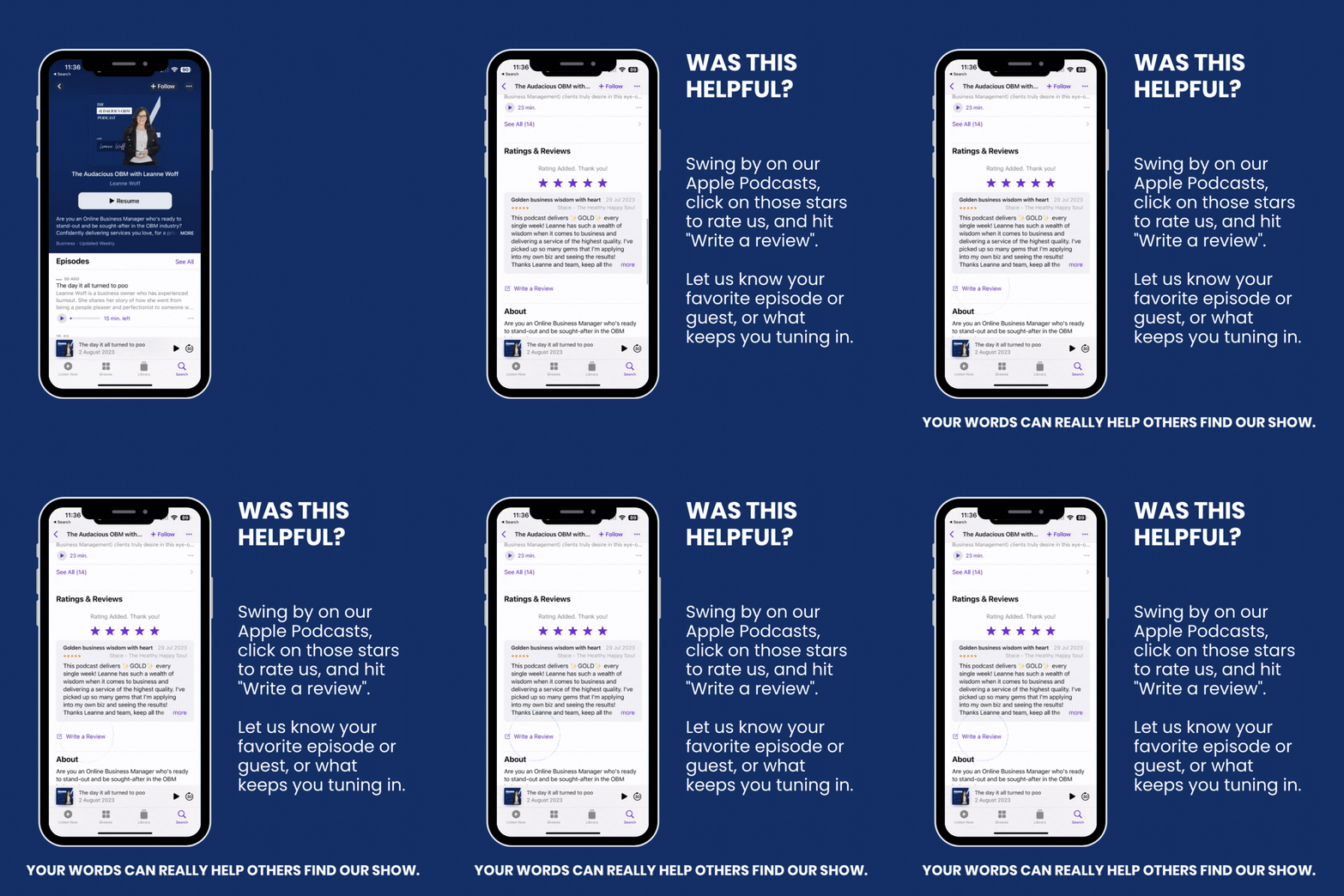
Then in a month, reflect and tweak it again and see what happens. You won’t be sorry, I promise you. If you listen to this episode and you’re going to go and try that, send me a DM and tell me. Because I’m in your corner and I want to know how you go. If you’re listening to this episode and you found it helpful, don’t forget to leave us a 5 star review because that’s how other people find us so we can help them too.


Want more OBM tips & tricks leads?

We’ve got just the resource for you.

Embark on your path to becoming a six-figure Online Business Manager with our comprehensive FREE roadmap. Gain insights into key strategies, and build the confidence needed to align your service with the value you bring. Don’t wait.
Hungry for more? Yearning to fast-track your journey to a successful, 6-figure OBM career? Our OBM Academy is here for you. Gain access to exclusive support, invaluable resources, and the tools you need to sharpen your skills and elevate your OBM career. Don’t miss this opportunity.
Follow along with the transcript

E39 How to stop getting crappy clients and leads that go nowhere.

Leanne Woff: Hey, hey lovely. Today we are going to talk about how to put an [00:01:00] end to attracting crappy clients and leads that go nowhere. The reason that I wanted to cover this today is because I’ve been having conversations with some of my clients in OBM Academy and some of my clients in Audacious OBMs about the different leads that they’re getting and the different clients that they’re landing, and we’re noticing some friction here. So today I want to share with you the different things that can happen and how you can put an end to this cycle. So there’s four main things that I want to cover. Why we start to attract crappy clients. How to know if this is what’s happening. The problem with your current approach to getting leads and clients.

And what you can do to get out of the crappy client spiral. So let’s start by looking at why we start attracting [00:02:00] crappy clients. I’m going to start with a story. One of the people that I was speaking to, one of my clients was saying, I’ve had a few different leads. One of them said, Hey, I need an email newsletter done once a month.

And. This is something that I do for a lot of my clients. It’s easy for me. I do it really well. And when I replied to this lead, they ended up going with someone else, and there wasn’t really much visibility as to why, and it left me feeling quite bleh. Because really, nobody likes not to get the job when we want the job.

We want to be able to win the work and feel good and deliver to the best of our ability all the time.

Now the reason that this has happened is because my client was in a commodity race. A commodity race is where there is something that is easily accessible by lots of people [00:03:00] and it’s readily available. So it’s competition everywhere because there’s many, many options to choose from. There’s no need to narrow down our choices.

And so then, because we’re human, we start to look at how do I make a decision? I have all of these options. How am I going to choose one? So I start to look for different things that will help me differentiate them. And generally in the OBM space, this is going to be price. It’s going to be the fastest person to respond.

I want this done yesterday. Who’s going to say yes. Or it’s going to be a microskill. in this situation, the microskill was I need someone who can do a marketing newsletter once a month. That’s it. My client is going, I do this all the time for people who [00:04:00] have a similar business to yours. And I know the kinds of things that will go into it and the kinds of things people will read when they open this newsletter, what will work for this community, the list goes on.

But the person on the other end never asked for any of that. And the likelihood is my client wasn’t able to share any of that because the person on the other end was just going, I need this job done. And I need someone who has this one skill. So we start attracting crappy clients when we’re competing with lots of other people.

We’re in a big pool of the same. And we don’t want that.

How to know if this is happening to you? It’s actually really simple and it comes down to the very first conversation when you get leads or clients and you ask them how they [00:05:00] found you. If you’re in this position, their response is going to be that they saw you answer a post. Oh, I saw you answer a post.

Or you were one of the people who sent me a reply to a job lead. Or, I just need someone who can do this thing. Or, I needed someone who could blah. They’re going to be really generic answers. And they’re going to be answers that tell you straight away, I’m looking at multiple people here. A lot of multiple people.

Or, the thing that I’m seeking is just for a microproblem to be solved. That’s how you know if this is happening. It’s that one question. How did you find me? What made you want to work with me? And see what they say. That response tells you everything. And quite often, if [00:06:00] you’re getting that generic kind of reply back, and it’s not something specifically about you, this lead is already a lot colder. And then that should gauge how much effort you’re going to put into it. So what’s the problem with this? The problem is that you’re putting yourself in competition from the get go. You are putting yourself in a defensive position. Immediately, you’re getting compared to different areas you don’t want to be compared on.

I don’t want to be compared by price. I don’t want to be compared to every other person that can put together a newsletter. Because I know the person on the other end is going to be overwhelmed with how much choice there is. And then I’m going to end up spending all of my time and my energy trying to get leads that don’t pay well and don’t value the [00:07:00] service.

So what we want to do is invest our time and our energy in better leads, in the right clients. And it’s not saying that these leads won’t become better leads or won’t become amazing clients, but what they’re looking for right now isn’t that. And so the amount of effort and energy we’re putting in is costing us that same effort and energy of how we could be going after the leads and clients we really want, that we can really get results for.

I don’t want you to feel like you have to justify yourself. So have you ever been on a call with someone and all of a sudden you feel like you have to justify why your price is your price? Or you have to justify why your process is your process? No, I can’t do it right this second because we need to do a work agreement.

I really need you to sign that work agreement. If you’re having to [00:08:00] defend things like that from the start, it’s not a great place to be and it doesn’t make you feel good. And again, it’s more time and energy and you feel like, in the very beginning of that relationship, you’re having to prove something.

Prove why. Prove the value. Prove why I should listen to you. Prove why your price is your price when I can get it cheaper down the street. Well, you know what? If you can get it cheaper down the street, go down the street because you get a say in how your business runs and that’s what we want to start showing people.

If we find that this is the position that we’re in, how do we get out of this spiral?

We want clients to chase us instead of us chasing them. Now what you’ll notice is that the way that you are getting clients, the way that you are [00:09:00] getting leads is the bit that is off here. And there are all different ways to get new leads and to get new clients. And some of them will get you far better ones, but the process can be longer. Sometimes we opt for, Hey, I’m going to comment on that Facebook post with a hundred other people that have commented, or I’m going to reply to these job leads, even though I know 50 other people are going to reply as well. I’m going to put my name in this directory. All of these things are fine to do.

And don’t get me wrong. Like I’m in directories. I love directories. I get tagged in Facebook posts and I’ll comment and say, Hey, this is what I’m all about. But, I don’t go to extreme levels of effort to chase those people down. I’m not going to message someone who’s posted a post on Facebook [00:10:00] 14 times to say, Hey, did you see my response?

Hey, did you see my response? I’m not banking on these people. I’ll use it for visibility. I’ll share more about my personality and who I am because then they can pick me. I want people to have the choice and not just be looking for the cheapest person, the fastest person. I want them to get to know me and want to work with me.

The reason for this is there is no one else like you. There’s just not, there is nobody else that has the same life experience, that has the same history, that has the same work experience, that has the same training, in the same way, in the same time as you do. And that is what we need to leverage to get out of this spiral.

The way that you do that is through your messaging. Your messaging is what you put out into the world. [00:11:00] Of who you are, what you do, what you’re about, who you help, and how you go about doing that. And so when we craft our message based on who it is we are, based on our journey, based on our experience, based on the reasons that someone should work with me. Based on who it is I want to work with or who I’ve gotten results for and what their lives look like, that is when I’ll start seeing people who will come because they want to work with me. They come and they know my name. They don’t want someone who’s an online business manager. They want someone from Audacious Empires.

Because I know they’ve worked with seven figure businesses. I know that they’re super honest. I know that they have systems and processes that work. Regardless of how much they cost, [00:12:00] I’m going to save up my money until I can work with them. That’s who I want. And that’s the position you need to be in.

To be top of mind for all of the different things that make you, you. It’s that combination of things that no one else can compete with. And that’s what we need to put at the forefront. That’s what we need to show people. Because if we’re not showing people that, we have no choice but to be in the commodity race.

We have no choice, but to pitch based on price or based on one skill. And then we get less say in what our business looks like, whether that’s because we don’t have as much money. So we have less avenues we can go down. We have less growth strategies. We have less ability to invest in new training, whether it’s, we have to do so much work that we don’t [00:13:00] have room to think strategically, what we want is for people to choose us for us and for us to be able to work with people who see the value. But the only way you can get there is to start showing people that, start telling them what’s so valuable about you. And it’s that combination. It’s not just your professional life. It’s not just showing people your resume.

Because here’s the kicker, right? People like doing business with people they like. Think about it. How often do you walk away from any business transaction and go, Ugh, I really do not like this person. But next week when I need a newsletter, I’m going back to them. You don’t. You want to work with people that inspire you or that feel good or that you [00:14:00] get along with.

People that you like. And more times than not, people will connect and like you based on who you are, not what you do. Show them who you are first, then show them what you do. That’s going to make connections for you. That’s going to build better clients for you. That’s going to create valuable services.

It’s going to make your business more profitable. And the best part is no one can compete with that because no one is you. Think about it. If you’re looking at buying a n Apple, You want a new Mac. You don’t walk in to the PC shop and say, I want a new Mac. You go straight to the Mac store. You go to Apple. Or you don’t walk into Apple and say, I want a PC.

You’ve walked in there specifically because you know exactly what you want. [00:15:00] And you don’t go in there and then argue about the price or go, Oh, maybe a PC would be better. I do not think that they’re the conversations people in Apple are having. Apple has built its brand so that it’s the brand that you want.

And you already know all the things that brand stands for. You know what you’re getting. And so you’ll save your money for the newest iPhone. Or you’ll save your money for the newest MacBook. Because that’s the one you want. This is what we need to do in our businesses. And we do that by sharing more of who we are, what we’re about, who we work for, with, who we get results for, and what it looks like with people.

But if we hide away and we don’t share any of this stuff, or we just put our hand up and say, yeah, I can do that for this much. We’re never [00:16:00] going to attract the clients that will really get the best from us and that we will love the work that we do for. And so if you’re finding that you’re getting crappy leads or you’re getting crappy clients and you’re just like, what is the problem here?

What am I doing wrong? Why do I have to keep proving myself? Why is this so hard? It’s because you need to work on your messaging. You need to think about what it is. That makes you different. And it could be a whole bunch of stuff that is the same. It could be, okay, there’s me and I’m set at $80 an hour.

There’s a lot of other people that are $80 an hour, but that’s just one piece. Okay. I’m an affordable OBM. What’s the next bit? I work really well with course creators. Okay. Now I’m an affordable OBM who gets results for course creators. Okay. [00:17:00] All of a sudden you’ve narrowed it down one step, just with that one extra bit, you’ve made your brand, the course creator OBM, the affordable course creator OBM.

Okay. I’m an OBM who is affordable, who works with course creators, who really loves jazz music. Can I tell you any course creator that likes jazz music is going to start paying attention the second that they hear that because they love jazz music. And you don’t have to say these things in every single sentence all the time, but it’s the stuff that goes, hey, you might be interested in me because we’re going to get along or because I’ve got what you need and we get along.

It’s that combination and it does not have to be this secret weapon that no one else has. You’re not saying [00:18:00] no one else likes jazz music, guys. What you’re saying is, I have the right combination of things for you. That is what will make people start chasing you. That is where you get the better clients.

That is where you get more money. That is where you stop looking at your emails and feeling so disappointed because you didn’t get the gig again. If you’re going to take one thing away from this, episode. It is to think about what your process for getting leads and clients is and how you can tweak your messaging a bit more and see what happens.

And then in a month, reflect and tweak it again and see what happens. You won’t be sorry, I promise you. If you listen to this episode and you’re going to go and try that, send me a DM and tell me. Because I’m in your [00:19:00] corner and I want to know how you go. If you’re listening to this episode and you found it helpful, don’t forget to leave us a 5 star review because that’s how other people find us so we can help them too.

I’ll see you next week guys.Ā 

The top five issues successful empire builders face today (and how you can fix them)

The top five issues successful empire builders face today (and how you can fix them)

Ā In my role as an OBM and an integrator, I talk to a lot of business owners—and successful ones. These are the five big issues that I’m seeing successful empire builders face and I’ll tell you how you can fix them.

I’m not talking about issues that only happen when you’re in a startup phase. These are issues that I see coming from seven-figure, eight-figure businesses and they’re all really easy to fix.

I want to give you insight so that if you are facing some of these, you don’t feel like you’re alone because a question I keep getting asked is, do you see other people that have this same problem? The answer is always, yes.

The likelihood is if you are facing a big issue, someone else is facing it too.Ā It is not just a you thing.

This episode shares:


  • The battle between impact and money: The two don’t always align. In fact, the two are tug of warring.Ā 
  • Keeping pace: When we are moving too fast, we lose strategic perspective and we generally lose quality.
  • Reinventing the wheel: When processes have no context, you can be doing the same things over and over again.
  • Busy without strategy: If you prioritise properly, things run a lot smoother and you reach goals faster.
  • Owning the role of CEO: Focusing on unique contributions that only the CEO can provide to the business’s growth and direction.


The battle between impact and money


The first of the issues that I want to cover is the battle between impact and money.

As Empire Builders we want to create a big impact. Usually, this is what started us on the journey that we are on now. We have a big purpose. We want to change the world. We want to make a difference. We have a fire in our belly that fuels us and very rarely does it have to do with us.

Most of the time, it’s about other people. The impact that we have on them, the world around them, the relationships that they have, and the life that they live. With that, we feel a big responsibility. We want to do everything that we can to support them, to create that impact, to grow that impact, to help more people, and for us, it does not feel optional.

We’re driven, it’s something we must do. If we can’t do it, we feel like we’re not doing the right thing. We’re not living up to what we’ve been called to do.

So how does that impact when it comes to money? What I see so often with Empire Builders is they have this desire to create the impact and they know that they need money from a business perspective. The two don’t always align. In fact, the two are tug of warring.

If you’re focused solely on impact, then the money side tends to fall over. If you’re focused solely on money, the impact side tends to fall over.

Which means we’re left in this place where we feel like we’re in a constant battle of having to choose and it is frustrating. But I want you to think about it this way. When we’re in this battle, our focus is split. We’re either looking at impact or we’re looking at money and we see them as opposing forces.

But what if we flipped it a little bit? What if we shifted our mindset so that we looked at the two as a collaboration, the impact needs the money. So it is Batman and Robin. One can’t really exist without the other. If you are focused on impact and you don’t look at the money side at all, what you will find is you will burn out very quickly. Or you won’t ever be able to make the kind of impact at the level that you want because you don’t have the money that supports it. This isn’t about greed or just revenue generation or anything like that. This is about, we need to have the resources to create that impact. Otherwise, we will end up having no impact.

If we don’t consider the money and the role the money plays, the vital role the money plays, on creating a big impact, we will have no impact. Because you will burn out, and if you burn out, you’re not helping anybody. There is no business, there is no you. There is no showing up, there is no sharing what you know, there is no getting the cut through that only you can get to, because there’s no fuel for that fire.

Then if we look at it the other way, there is no money without the impact. That is because you’re an Empire Builder. You don’t do things in halves. You don’t do things, just to take the first step and run away. If there is no impact, there’s no money. That’s because, without the impact, you’re not in it.

That impact needs you, and the money will only come if that impact is being made because that impact is what fuels you. It’s what keeps you going. It’s what keeps you seeing these are the opportunities in front of me. If you’re in a place where all you have to focus on is money or making money, you’re not going to sustain what you’re doing, because that’s not why you started doing this.

It might be part of the reason. But I bet you it’s not the sole reason. If we don’t show you the impact that you’re having and you can’t see it unfolding, there’s going to be no money because you’re not going to back it and the money needs you.

When we’re looking at this battle of impact versus money, you need to flip your mindset and see it as it’s not a battle. They feed each other and each is just as important and that means we need to give each the right amount of attention. They both need our time and our commitment so that we can keep growing.

If we just focus on one, that’s when things get wobbly. So remember, we need to cover both bases. Make the time to cover both bases.

Keeping pace

Empire Builders tend to have two modes, that are default. So this is in terms of, without trying, one is moving too fast, the other is moving too slow. They’re the default. Until we start to rationalise and until we start to really commit to changing the way that we operate, that’s just the status quo.

But both of these have issues and have consequences.

When we are moving too fast, we lose strategic perspective and we generally lose quality.

Our focus becomes on speed or our focus becomes on immediate impact, immediate outcome and that just adds pressure. The faster that you’re moving, the more pressure that gets added, especially if it’s not backed with strategy, and there’s a whole lot of reasons that we move quickly. We’re excited. We feel like this is urgent and it needs to be solved right now. We can see an opportunity and we don’t want to miss it. There are lots of reasons. Sometimes we just feel anxious or we just want to feel like we’ve achieved something, so we move faster.

But very rarely is the outcome as good as what it could have been if we took a breath first. On the flip side, if we’re moving too slow, we start to lose opportunities and when I see empires moving too slow, most of the time it has to do with a decision. They need to make a decision about something, or they’re procrastinating doing something.

It’s that delay that misses them opportunities and it actually causes mental exhaustion.

Because even if you’re not doing it, you still know that you need to. You still know that there’s a choice that needs to be made, or there’s a thing that needs to be done. In your mind, in the background, that’s still sitting there.Ā It takes that little bit of your energy.

Now imagine that. Ten choices. Fifteen. Twenty. That little bit of energy isn’t little anymore. Because it’s happening across all these different areas. Then we’re suffering the consequences of moving too slowly, of being unsure. So what we need to do is work out a better balance.

We need to know when to move quickly and when moving a bit slower is okay. The way that we do that is to know your core drivers. When I’m working with a lot of my clients, I usually am in on what all their goals are and I know them as people. So I know as people what’s important to them and I know from a business perspective what’s important to it.

That means that when we’re having conversations I already know what the crucial pieces are here. I know where we’re headed. I know where we’re headed based on a business front and based on a human front. When there’s a decision that needs to be made or when there’s a really exciting opportunity that lands in our lap or a new thought that pops into our minds and the things that could develop to be, I have something to go back to because I can measure every opportunity or every decision against these core drivers. Is this something that is moving with us in alignment with those drivers and these goals? Or is it something completely off to the side? Because every time we choose something that is off to the side, it means that something’s taken away from one of our core drivers and are we okay with that? So often we can’t make a decision until we understand the consequence of that decision. Sometimes the answer might be, yeah, it’s actually okay in this scenario to take that opportunity and to do it and to do it quickly, because that actually feeds straight into what we’re doing.

But sometimes it just means you’re taking away focus, energy, and time. From the things that really need it now, that you’d already decided without emotion, without urgency. The more that we can come back and have that tangible, measurable plan to go back to, you’ll make far better decisions and you’ll be able to keep a better pace.

Because you won’t be constantly going between fast, fast, fast, or slow, slow, slow.

Reinventing the wheel


This is something I hear from people that I work with a lot.

“I feel like I’m reinventing the wheel. I’m organised, but even if I’m organised, I still feel like I’m doing the same things that I’ve already done. There has to be an easier way.”

Usually, this stems from Empire Builders trying to be organised and creating processes.

I’m an OBM and an Integrator, so I love processes. But I also know that the second that you create a process, the second that you document it, it’s pretty much out of date because time has moved forward and time changes things.

I also know that processes that are contained within a system have context and context is what makes your processes long-lasting. So we’re constantly reinventing the wheel and doing the same things over and over again, even though we have processes because those processes have no context. They don’t know how to function and be of use without you or the person that wrote them. We need to start looking at what are the systems in our businesses these processes support because that’s when we start to see systems of scale. That’s when we start to see a reduction in the impact of people changing roles or leaving or coming in. The impact of that. The reason being that the systems are not built for any one person.

They’re built for the business as a whole. The processes tie back into those systems. The two feed each other and that’s what makes them last longer because they can be done by anyone with any knowledge of that role because the context is there. They don’t have to know when to use this process, why to use this process, whether it’s this process or the other process.

If I change something in this process, is it going to affect a different process? Will it affect a different team? What will that do to the bottom line? There are all these things that happen within processes if you leave them without a system. Put them in systems and then the systems work together and the picture makes sense.

It’s that clarity that will keep your business driving forward and you won’t be reinventing the wheel anymore. The wheels are already there in motion, you might just support them and improve them.


Busy without strategy

The fourth thing is being busy but not strategic.

We’re Empire Builders, who like to be busy. Usually, it’s because being busy makes us feel like we’re closer to the impact we want to make, or we feel productive. But, being busy and being strategic are not the same thing, you might be doing a lot. Let’s be honest.

Most of our Empire Builders out there are doing a lot but it might not be the right thing. When we’re not focused on the right things, we go round in circles. At least that’s what it feels like. Whenever really moving forward, sure, we’re getting a lot done. We’re getting through a lot. I’m not really seeing the outcome of that and that’s because we’re being busy. I also want to add the context of what is business today might not be in a month. The things I do today that would be counted as busy things, that I’m not going to see the impact for, in a month’s time, they might be the right things, and I’d see the impact very quickly.

Therefore, in that scenario, they’re not busy anymore. The difference is the timing and the priority. This is how we fix our constant lack of time, even though we’re doing lots. We start to look at prioritisation. Priorities fix everything. If you know what to do when to do it, and why that we have to do it in that order, in that way.

You will get to your outcomes far quicker. It’s methodical. It’s planned out and you won’t burn out as easy. You’re seeing impact faster. You’re jumping a lot of hurdles when you do things in the right order. That’s just how project rollout works. That’s how operations work. If you prioritise properly, things run a lot smoother and you reach your goals faster.

If you’re in that position, what I really want you to do is take a look at where all your time is going. Really, where’s your time going? Before you go to do the next thing, think about why you’re doing that. What is the purpose? What do you want that thing to get you? Is that something that’s going to happen soon?

Or maybe is there something else that you time is better served doing and then shift. It’s okay to shift. It’s okay to change the scope of different things. Nothing ever has to be set in stone, especially if we wanna be constantly moving. Nothing ever stays still if we’re moving. So you’ve gotta be flexible and that’s okay.

Owning the role of CEO


The last thing that I want to talk to you about is owning the role of CEO.

You might be thinking, that doesn’t really sound like an issue. That just sounds like a dream, but can I tell you, I see Empire Builders spending way too much of their time doing other people’s jobs, not being CEO.

Not because they have to, but they do. Just because you can do something doesn’t mean you should do it. Just because you can do it well, doesn’t mean that you should do it just because you can do it faster than someone else also doesn’t mean you should do it.

Not if you want to be the CEO, getting the opportunity cost in a business, there is only ever one CEO. There’s lots of workers. There’s lots of people in the organisation and they all have their part to play. There’s only ever one CEO. That means you have to choose, that means every time you do something that isn’t in your CEO role that someone else could be doing, you’re choosing not to do your CEO role.

Your time and energy are getting taken up by something that isn’t serving you. Someone else can do it. Whether they’ll do it as good as you, whether they’ll do it as fast as you, whether they’ll do it in the same way you would. Totally different story. But the truth of the matter is, only one person can be the CEO.

If that person isn’t you, no one else is doing it. What will happen to your business if they have a CEO who’s there most of the time but then sometimes just disappears? Things won’t stay on track. Things wouldn’t get to where they could be as quickly as they could if they had a CEO who was leading.

Every time we choose to jump into somebody else’s job, someone else’s task, something that someone else can do that is not a you-only thing.

We often desperately want to be CEO, but the reality is it’s harder for us to stay there. Or to work our way up to staying in that role, because it’s a new way to operate. It’s not the same as it’s always been. If I’m an admin assistant, there’s four admin assistants. There’s four of me. There’s more wiggle room for my role.

If you’re the CEO, there’s only one of you. There’s no fallback here. So, we have to operate differently. To do that, you need to start looking at your capacity and look at all the things that you’re doing. Can anybody else do any of those things? What are the things on there? Only you can do, nobody else, because they’re the things you need to be aiming to do all of the time.

It doesn’t mean that you have to be doing it all tomorrow, but you’re setting yourself a baseline and you’re understanding,Ā  this is what my role should be. You’re starting to see the gaps and the opportunities to grow because if you’re doing things that other people could be doing, it means that you’re not spending that time looking at growth or impact or new opportunities.None of those things will happen unless you’re managing it.

As much as we can, we want to start building our team and bringing in the right people in the right roles where you’re not needed. Then we equip those people to do the best that they can do and it might look different to you and you know what? Most of the time, the results they get, they’re going to be better than the results you would have gotten because that’s their jam.

Your job is to be at the head of the table. We want to own the CEO role, but we need to understand what that really means and be practical about getting there because it won’t happen overnight. Just like success doesn’t happen overnight. Creating a little bit of a transition plan is okay. It’s practical. It’s saying, all right, I want to move forward. One step forward is still one step forward.

Wrapping It Up

So they’re the five big things that I talk to my clients about, that I talk to Empire Builders about, that I’m seeing right now in 2024.Ā 

Need help creating amazing client offboarding experiences?

We’ve got just the resource for you.

Embark on your path to becoming a six-figure Online Business Manager with our comprehensive FREE roadmap. Gain insights into key strategies, and build the confidence needed to align your service with the value you bring. Don’t wait.

Hungry for more? Yearning to fast-track your journey to a successful, 6-figure OBM career? Our OBM Academy is here for you. Gain access to exclusive support, invaluable resources, and the tools you need to sharpen your skills and elevate your OBM career. Don’t miss this opportunity.
Follow along with the transcript

AEP E7 The top five issues successful empire builders face today (and how you can fix them)

Hey, hey, hey! Welcome to this week’s episode of [00:01:00] the Audacious Empires podcast. Today, I want to talk to you about five of the big issues that I’m seeing successful empire builders face and how you can fix them. In my role as an OBM and an integrator, I talk to a lot of business owners. And successful ones.

So I’m not talking today about issues that, only happen when you’re in a startup phase. These are issues that I see coming from seven figure, eight figure businesses. And they’re all really easy to fix. But I wanted to give you the insight so that if you are facing some of these, you don’t feel like you’re alone.

Because that’s another question I keep getting asked is, do you see other people that have this same problem? The answer is always, yes. The likelihood is if you are facing a big issue, someone else is facing it too. And there are all different [00:02:00] ways that you can go about fixing that issue. It is not just a you thing.

So let’s dive in. The first of the issues that I want to cover is the battle between impact and money, as Empire Builders we want to create a big impact. Usually, this is what started us on the journey that we are on now. We have a big purpose. We want to change the world. We want to make a difference. We have a fire in our belly that fuels us. and very rarely does it have to do with us.Ā 

Most of the time, it’s about other people.

And the impact that we have on them, the world around them, the relationships that they have, the life that they live. And so with that, we feel a big responsibility. We want to do everything that we can to support them, to create that impact, to grow that impact, to help more people, and for us, it does not feel optional.

We’re driven. We, it’s something we must do. If we can’t do it, we feel like we’re not doing the right thing. We’re not living up to what we’ve been called to do.

So how does that impact when it comes to money? What I see so often with empire builders is they have this desire to create the impact and they know that they need money from a business perspective. The two don’t always align. In fact, the two are tug of warring. If you’re focused solely on impact, then the money side tends to fall over.

If you’re focused solely on money, the impact side tends to fall over.

Which means we’re left in this place. Where we feel like we’re in a battle all the time of having to choose and it is frustrating. But I want you to think about it this way. When we’re in this battle, our focus is split. We’re either looking at impact or we’re looking at money and we see them as opposing forces.

But what if we flipped it a little bit? And what if we shifted our mindset so that we looked at the two as a collaboration, the impact needs the money. So it is Batman and Robin. One can’t really exist without the other. If you are focused on impact and you don’t look at the money side at all, what you will find is you will burn out very quickly.

[00:05:00] Or you won’t ever be able to make the kind of impact at the level that you want because you don’t have the money that supports it. This isn’t about greed or just revenue generation or anything like that. This is about, we need to have the resources to create that impact. Otherwise, We will end up having no impact.

I will say it again. If we don’t consider the money and the role the money plays, the vital role the money plays, on creating a big impact, we will have no impact. Because you will burn out, and if you burn out, You’re not helping anybody. There is no business, there is no you. There is no showing up, there is no sharing what you know, there is no getting the cut through that only you can get to, because [00:06:00] there’s no fuel for that fire.

And then if we look at it in the other way, There is no money without the impact. That is because you’re an empire builder. You don’t do things in halves. You don’t do things, just to take the first step and run away. If there is no impact, there’s no money. And that’s because without the impact, you’re not in it.

That impact needs you, and the money will only come if that impact is being made, because that impact is what fuels you. It’s what keeps you going. It’s what keeps you seeing these are the opportunities in front of me. If you’re in a place where all you have to focus on is money or making money, you’re not going to sustain what you’re doing, because that’s not why you started doing this.

It might be part of the reason. But I bet you it’s not the sole [00:07:00] reason. And so if we don’t show you the impact that you’re having and you can’t see it unfolding, there’s going to be no money because you’re not going to back it and the money needs you.

When we’re looking at this battle of impact versus money, you need to flip your mindset and see it as it’s not a battle. They feed each other and each is just as important. And that means we need to give each the right amount of attention. They both need our time and our commitment so that we can keep growing.

And if we just focus on one, that’s when things get wobbly. So remember, we need to cover both bases. Make the time to cover both bases.

The second issue that I see is keeping pace.

Empire Builders tend to have [00:08:00] two modes. That are default. So this is in terms of, without trying, one is moving too fast, the other is moving too slow. They’re the default. Until we start to rationalise and until we start to really commit to changing the way that we operate, that’s just the status quo.

But both of these have issues and have consequences. When we are moving too fast, we lose strategic perspective and we generally lose quality. Our focus becomes on speed or our focus becomes on immediate impact, immediate outcome. And that just adds pressure. The faster that you’re moving, the more pressure that gets added, especially if it’s not backed with strategy.

And there’s a whole lot of reasons that we move quickly. We’re excited. We feel like this is urgent and it needs to be solved right [00:09:00] now. We can see an opportunity and we don’t want to miss it. There are lots of reasons. Sometimes we just feel anxious or we just want to feel like we’ve achieved something, so we move faster.

But very rarely is the outcome as good as what it could have been if we took a breath first. And then, on the flip side, if we’re moving too slow, we start to lose opportunities. And when I see empires moving too slow, most of the time it has to do with a decision. They need to make a decision about something, or they’re procrastinating doing something.

And it’s that delay that misses them opportunities, and it actually causes mental exhaustion. Because even if you’re not doing it, you still know that you need to. You still know that there’s a choice that needs to be made, or there’s a thing that needs to be done. And in your [00:10:00] mind, in the background, that’s still sitting there.

And it takes that little bit of your energy. Now imagine that. Ten choices. Fifteen. Twenty. That little bit of energy isn’t little anymore. Because it’s happening across all these different areas. And so then we’re suffering the consequences of moving too slowly, of being unsure. So what we need to do is work out a better balance.

We need to know when to move quickly and when moving a bit slower is okay. And the way that we do that is to know your core drivers. When I’m working with a lot of my clients, I usually am in on what all their goals are and I know them as people. So I know as people what’s important to them and I know from a business perspective [00:11:00] what’s important to it.

That means that when we’re having conversations I already know what the crucial pieces are here. I know where we’re headed. I know where we’re headed based on a business front and based on a human front. And because those are clear for me. When there’s a decision that needs to be made or when there’s a really exciting opportunity that lands in our lap or a new thought that pops into our minds and the things that could develop to be, I have something to go back to because I can measure.

Every opportunity or every decision against these core drivers. Is this something that is moving with us in alignment with those drivers and these goals? Or is it something completely off to the side? Because every time we choose something that is off to the side, it means that something’s taken away from one of our core [00:12:00] drivers.

And are we okay with that? So often we can’t make a decision until we understand the consequence of that decision. And sometimes the answer might be, yeah, it’s actually okay in this scenario to take that opportunity and to do it and to do it quickly, because that actually feeds straight into what we’re doing.

But sometimes it just means you’re taking away focus, energy, and time. From the things that really need it now, that you’d already decided without emotion, without urgency. The more that we can come back and have that tangible, measurable plan to go back to, you’ll make far better decisions and you’ll be able to keep a better pace.

Because you won’t be constantly going between fast, fast, fast, or slow, slow, slow. The third thing is reinventing the wheel. *This is something I hear from people that I work with a lot. I feel like I’m reinventing the wheel. I’m [00:13:00] organised, but even if I’m organised, I still feel like I’m doing the same things that I’ve already done.

There has to be an easier way. Usually, this stems from empire builders trying to be organised and creating processes. Now, I’m an OBM and an integrator, so I love processes. But I also know that the second that you create a process, the second that you document it, it’s pretty much out of date because time has moved forward and time changes things.

I also know that processes that are contained within a system have context and context is what makes your processes longlasting. So we’re constantly reinventing the wheel and doing the same things over and over again, even though we have processes, because those processes have no context. They don’t know how to [00:14:00] function and be of use without you or the person that wrote them.

So we need to start looking at what are the systems in our businesses. That these processes support because that’s when we start to see systems of scale. That’s when we start to see a reduction in the impact of people changing roles or leaving or coming in. The impact of that. The reason being that the systems are not built for any one person.

They’re built for the business as a whole. And the processes tie back into those systems. The two feed each other and that’s what makes them last longer because they can be done by anyone with any knowledge of that role because the context is there. They don’t have to know when to use this process, why to use this process, whether it’s this process or the other process.

If I change something in this process, is it going to affect a different process? Will it [00:15:00] affect a different team? What will that do to the bottom line? There are all these things that happen within processes if you leave them without a system. Put them in systems and then the systems work together and the picture makes sense.

It’s that clarity that will keep your business driving forward and you won’t be reinventing the wheel anymore. The wheels are already there in motion, you might just support them and improve them.

The fourth thing is being busy but not strategic. We’re Empire Builders. We like to be busy. Usually, it’s because being busy makes us feel like we’re closer to the impact we want to make, or we feel productive. But, being busy and being strategic are not the same thing. And you might be doing a lot. Let’s be honest.

Most of our Empire Builders [00:16:00] out there are doing a lot. But it might not be the right things. When we’re not focused on the right things, we go round in circles. At least that’s what it feels like. Whenever really moving forward, sure, we’re getting a lot done. We’re getting through a lot. I’m not really seeing the outcome of that.

And that’s because we’re being busy. I also want to add the context of what is business today might not be in a month. The things I do today that would be counted as busy things, that I’m not going to see the impact for, in a month’s time, they might be the right things, and I’d see the impact very quickly.

Therefore, in that scenario, they’re not busy anymore. The difference is the timing and the priority. This is how we fix our constant lack of time, [00:17:00] even though we’re doing lots. We start to look at prioritisation. Priorities fix everything. If you know what to do when to do it, and why that we have to do it in that order, in that way.

You will get to your outcomes far quicker. It’s methodical. It’s planned out. And you won’t burn out as easy. You’re seeing impact faster. You’re jumping a lot of hurdles when you do things in the right order. That’s just how project rollout works. That’s how operations work. If you prioritise properly, things run a lot smoother and you reach your goals faster.

So if you’re in that position, what I really want you to do is take a look at where all your time is going. Really, where’s your time going? And before you go to do the next thing, go do the [00:18:00] next thing, think about why you’re doing that. What is the purpose? And what do you want that thing to get you? And is that something that’s going to happen soon?

Or maybe is there something else that you That your time is better served doing and then shift. It’s okay to shift. It’s okay to change the scope of different things. Nothing ever has to be set in stone, especially if we wanna be constantly moving. Nothing ever stays still if we’re moving. So you’ve gotta be flexible and that’s okay. And then the last thing that I wanna talk to you about is owning the role of CEO.

Now you might be thinking, that doesn’t really sound like an issue. That just sounds like a dream, but can I tell you, I see empire builders [00:19:00] spending way too much of their time doing other people’s jobs, not being CEO. Not because they have to, but they do.

Just because you can do something doesn’t mean you should do it. Just because you can do it well, doesn’t Doesn’t mean that you should do it just because you can do it faster than someone else also doesn’t mean you should do it. Not if you want to be the CEO, getting the opportunity cost in a business, there is only ever one CEO. There’s lots of workers. There’s lots of people in the organisation and they all have their part to play. There’s only ever one CEO. That means you have to choose. And that means every time you do something that isn’t in your CEO role that someone else could be doing, you’re choosing not to do your CEO role.

Your time and energy are getting taken up by something that isn’t serving you. Someone else can do it. Whether they’ll do it as good as you, whether they’ll do it as fast as you, whether they’ll do it in the same way you would. Totally different story. But the truth of the matter is, only one person can be the CEO.

And if that person isn’t you, no one else is doing it. And what will happen to your business if they have a CEO who’s there most of the time but then sometimes just [00:21:00] disappears? Things won’t stay on track. Things won’t get to where they could be as quickly as they could if they had a CEO who was leading.

And every time we choose to jump into somebody else’s job, someone else’s task, something that someone else can do that is not a you only thing.Ā 

We often desperately want to be CEO, but the reality is it’s harder for us to stay there. Or to work our way up to staying in that role, because it’s a new way to operate. It’s not the same as it’s always been. If I’m an admin assistant, there’s four admin assistants. There’s four of me. There’s more wiggle room for my role.

If you’re the CEO, there’s only one of you. There’s no fallback here. So, we have to operate differently. To do that, [00:22:00] you need to start looking at your capacity. And look at all the things that you’re doing. Can anybody else do any of those things? What are the things on there? Only you can do, nobody else, because they’re the things you need to be aiming to do all of the time.

It doesn’t mean that you have to be doing it all tomorrow, but you’re setting yourself a baseline and you’re understanding, hey, this is what my role should be. And you’re starting to see the gaps and the opportunities to grow. Because if you’re doing things that other people could be doing, it means that you’re not spending that time looking at growth.

Or impact or new opportunities. And none of those things will happen unless you’re managing it. So as much as we can, we want to start building our team and bringing in the right people in the right [00:23:00] roles where you’re not needed. And then we equip those people to do the best that they can do. And it might look different to you.

And you know what? Most of the time, the results they get. They’re going to be better than the results you would have gotten because that’s their jam. Your job is to be at the head of the table. And so we want to own the CEO role, but we need to understand what that really means and be practical about getting there because it won’t happen overnight.

Just like success doesn’t happen overnight. And creating a little bit of a transition plan is okay. It’s practical. It’s saying, all right, I want to move forward. One step forward is still one step forward. So they’re the five big things that I talk to my clients about, that I talk to empire builders about, that I’m seeing right now in 2024.

And hopefully this episode has given [00:24:00] you the starting points on how to overcome those issues and not stay stuck in them. Because the world needs you to be the best you that you can be. That’s where the impact happens. That’s when the world changing happens. I’ll see you next week, everyone bye.Ā 

What’s the difference between a Virtual Assistant and an Online Business Manager?

What’s the difference between a Virtual Assistant and an Online Business Manager?

The number one question that gets asked of Virtual Assistants and Online Business Managers is, what’s the difference between a Virtual Assistant and an Online Business Manager?

I don’t think I have met a person who hasn’t asked this question.

As an empire builder, you’re constantly seeking ways to work smarter, build your brand, and amplify your impact. But with the day-to-day tasks of running a business, it’s easy to lose time and focus on what truly matters: creating a lasting legacy and experiencing life to the fullest.

You’ve likely heard of virtual assistants (VAs) and online business managers (OBMs), but what’s the difference, and which one does your growing empire need? In this blog post, we’ll dive deep into the world of VAs and OBMs, exploring their unique skills, pricing, and involvement in your business. By the end, you’ll have a clear understanding of which choice is the best fit for you: a skilled task-master or a dedicated growth partner.

Ā 

This episode shares:


  • Understand the terminology: An online business manager (OBM) is a virtual assistant (VA) who has specialised in business management, working remotely and utilising technology.
  • Focus on the end goal: General admin VAs are primarily task-based, while OBMs look at the bigger picture, considering the entire process flow and system to achieve business goals.
  • Distinct skill sets: General admin VAs have niched down into general administration, while OBMs boast high attention to detail, strategic focus, and operational project management skills, all based on a solid understanding of running a business.
  • Training and development: General admin VAs typically train in skills specific to their service offerings, whereas OBMs consistently invest in broad skills that support all of their service offerings.
  • Business management and operations understanding: General admin VAs possess a great understanding of their specific role, while OBMs immerse themselves in the client’s business, grasping the interplay of various components that make it successful.
  • Depth of involvement: General admin VAs are usually ankle-deep in a business, managing tasks within their zone of genius, while OBMs are fully immersed, seeking ways to improve and grow the business.
  • Relationships within your business: General admin VAs often build relationships with the business owner or manager, while OBMs develop relationships with all stakeholders, including team members, customers, and suppliers.
  • Proactivity and initiative: General admin VAs are proactive within their contracted services, while OBMs exhibit hyper-proactivity across the entire business, anticipating challenges and seizing opportunities.
  • Level of personal attention: General admin VAs typically have more capacity and a larger client base, while OBMs work with a limited number of clients, ensuring a high level of personal attention and commitment.
  • Assessing your needs: To determine whether you need a General admin VA or an OBM, consider if you want someone to handle specific tasks or a fully-immersed growth partner.


Terminology


An OBM is a Virtual Assistant.

Dun, dun, dun. What does that mean?

When Virtual Assistants began, they were primarily admin assistants. They were people who had secretarial skills and when the internet became a thing, that’s when Virtual Assistants started to begin.

Over time though, the industry has grown and changed at the same speed as technology like this was founded on the internet. So as technology grows and expands, so does the industry and the people within the industry and the things that you can do within this industry.

So what a VA used to be known as is not accurate anymore.

There is the VA industry, and that is anybody who offers business services in an online manner. Remotely. Contractors.

There are lots of different specialties within that industry as a whole. An Online Business Manager is a VA who has specialised in business management and does their work online.

When we sayĀ VA, what we’re referring to is a general admin VA. Somebody who has niched down into providing general admin services across businesses.


My journey from admin Virtual Assistant to Online Business Manager


Now that we have cleared that up and we all know what we’re talking about, I want to share a little story.

For a long time, I was a general admin VA. At least I referred to myself as an admin VA.

One day, one of my clients said to me, “Leanne, you are not an admin Virtual Assistant.” And I was a little bit confused. If I’m not a virtual assistant, what am I?

They said to me, “you’re an Online Business Manager. The way that you see my business, the skills that you have, and the way that you run your business as well as my business, that tells me you’re not a admin VA. If you put what you do and what an admin VA does side by side, it’s very different.” And I thought, huh, this sounds interesting.

So I explored it a little bit further and what I found was amazing and then I transformed my business at that point because it made so much sense. I had been frustrated at the level of VAs that weren’t really running businesses, they just decided, I can use words, so I’m going to charge for it and getting compared to people like that, getting compared to $5 an hour cheaper services, thinking, but they can’t do what I can do. And it’s because we weren’t doing the same things. I wasn’t comparing apples with apples.

I would love to share with you what I really learnt and what the differences are between a VA and an OBM. There are 9 things we’re going to go through.


1. Focus on the end goal

  • Admin VA: Task-level focus – timely and professional.
  • OBM: Task and end goal focus – improve and upgrade processes to achieve goals efficiently.

An admin VA is primarily task-based.

They are exceptional at completing certain jobs or certain tasks in a timely or professional manner. They look at the task, they look at the extent of the task, they do it, they come back to you with a job well done.

An OBM looks at the bigger picture.

If we are looking at one task, we’re not just looking at that task, we’re looking at the whole process flow and we’re looking at the system around that task.

What’s the purpose of it? What is the way that we approach this? Is that the best way? If this task was done in a different way what would the impact be on the rest of the process? What do the pieces involved in this task and process do to achieve our end goals?

We (OBMs) want to see the bigger picture. We want to see everything within a business working in a system to support the business goals. So we’re looking at that entire machine rather than looking at the goal of the task.


2. Different skill sets

  • Admin VA: General admin skills and/or niche skills.
  • OBM: Admin skills, with a focus on strategic operations, project management, and a comprehensive understanding of running a business.

ā€œLife is much easier for everyone when you have people around you who genuinely get it, want it, and have the capacity to do it.ā€ ― Gino Wickman,Ā Traction: Get a Grip on Your Business

VAs have niched down into that general administration. So it’s across the board business admin.

An OBM has admin skills. Generally, we didn’t just start with all this knowledge and this capability. At some point, we’ve been in admin roles, we understand admin, but in a role of an OBM, that’s not our focus and it shouldn’t be our focus, because our jam is to have high attention to detail, a strategic focus, and looking at and managing operations.

We also have a really solid understanding of what it takes to run a business. A business as a whole, not just a piece of it or a niche of it.

What impact does the technology have on that? What impact does the team have on? OBMs will focus their energy on getting all of the pieces in a business established and working towards that big end goal.

Whereas admin VAs are exceptional to a deep level at their tasks.


3. Training and development

  • Admin VAs: Skill-specific training or experience-based, often engage in annual training.
  • OBMs: Comprehensive training, regularly updated, and a higher financial investment in their development.

Admin VAs will generally train in skills specific to their service offerings, to their niche.

They’re the things they do every day, or they rely on their previous experience in terms of administration and administrative tasks. They might change a little bit, but the whole foundation of what they do and what they are don’t change at a rapid pace.

A lot of VAs will do some kind of annual training, they’ll brush up on something that tends to be the pattern in the industry.

OBMs train in skills that support all of their service offerings and they update their skills regularly. As an OBM, I want to know how to make my business run better.

When I’m learning how to make my business run better, I’m learning how to make your business run better. So it has an ecosystem of expansion and education. OBMs will generally invest in more training and they will spend more money.

In that training, we seek it, we make it a pillar in our businesses, especially when our role is to lead and guide and know, we need to have the most up to date understanding of things that are going on in business world. OBMs don’t just schedule in annual training, we don’t stop training. What I mean by that is we do formal education and enrol in courses.

If you’ve got an OBM who’s not learning every day, they probably aren’t a good one.

Yes, I said it. Because when an OBM is faced with a new scenario or a problem, it’s their job to go and find a solution. It’s their job to be able to learn and adapt and make executive decisions as the business grows and changes.

Every day we’re learning all the tools and resources that will help grow your business to get us there. Put aside annual training time. We learn and we grow and we change every day. It is built in to our role. We will be learning how to run your business better and how to run our business better. So think about it. Every time I am upscaling or expanding my knowledge to make my business grow and run smoother, I’m getting all that same knowledge to do it for your business. Then when I’m doing that same thing for your business, it’s boosting my knowledge from my business and it’s this awesome little ecosystem that starts to happen.

OBMs will generally invest more financially in training because of how paramount it is to our role.

If you have an OBM who isn’t consistently learning or updating their skills or interested in what’s happening and what’s working today, They probably aren’t a very good one. We need to be curious. We need to be interested. We need to be invested in growth of ourselves and of your business and because of what we do is all about making sure the business is doing everything it can in an easy way to achieve its goals, we need to be equipped with up to date knowledge.

We need to know what’s working in business land right now. We need to know if something has changed between last year and this year. We’re core team members. If there is a problem, or if we’re looking at an opportunity where we need new ways to do things, an OBM will goĀ and find the solution.

They will go and solve the problem and if they don’t know how, they will learn. That’s the idea here. It is not a situation where we see a problem, or we have this desire to achieve something new, and then we just stop and go, sorry, I don’t know. We need to be consistently learning and OBMs learn every single day, every day in my business.

I am learning. I very much, in myself, like to keep my skills up to date. I’m an avid learner, and I enjoy it, and I’m naturally curious. I’m, I naturally want to do the things better, and I want to learn how to improve, and I want to learn how to tweak things, or explore completely new options that flips everything on its head.

That gets a better impact. That’s the aim of the game here. So when technology moves as fast as it does, when people move as fast as theyĀ do, when team members have different personalities and change, you need to be able to grow and expand with all these changes.


4. Price point and pricing structure

  • Admin VAs: $45-$50* entry-level hourly rate, with packages for set tasks and discounts for multiple hours.
  • OBMs: Outcome-focused packages, usually starting at $75* per hour, reflecting their skills, knowledge, and dedication.

*As at 2024 in Australia

How much do VAs charge? How much do OBMs charge?

For general admin VAs in Australia, at the moment in 2024, the entry level rate is about $45-50 an hour at AUD. That’s for someone who has the skill to be an administration assistant.

Maybe they have worked in admin as an employee and now they’re going to do it in their business. So they’ve got that skill set, but might be new to the industry or new to running their own business. That’s the entry level. Anybody that is charging less than that hasn’t really invested in their business at all yet.

If they’re charging less than that, they are selling themselves short, and they’re not considering the expenses that exist running a business. But generally, someone entering this industry at the moment, $45-50 an hour, and they tend to charge in at an hourly rate. They also usually will do retainers where they’ll package up a bunch of hours and then you’ll get a little bit of a discount because you’re buying hours of their time in advance.

Some will then niche down into certain services. So they might have a particular skill. Let’s say they are in general admin, but they have a flair for design – they might then use that as an add on to their service.Ā 

If you’re working with an OBM, it’s a little bit of a different structure. OBMs will be shifting away from charging an hourly rate because when you charge an hourly rate, you are putting all of the weight on the client. If I charge you an hourly rate, I’m saying to you how good I am at my job will impact how much you then pay for.

So if I take longer to do something because I haven’t bothered to increase my training, increase my skills, you’re paying for that. If you need a certain job done and it takes me longer and then you’ve run out of hours, well guess what? That job ain’t getting finished. Or you have to pay me more for it.

If we flip that and we look at the outcome, hey, I need someone who’s going to do this for me. I want this complete and OBM will then come back to you with that. This is how much that will cost, not a, this is how much time it will take. Therefore, this is how much it will cost. They’re factoring in if something goes wrong, if everything goes smoothly, if there’s additional costs or they’re going to have to work, different hours or whatever that might be.

They’re taking the responsibility for the outcome. Not you. So, when you work with an OBM, you’re going to get the result that you’re wanting. You’re going to get that thing finished or things happening the way they should without the price fluctuating. The other thing that you need to think about with OBMs is that when they are packaging up their services, they’re packaging up the level of knowledge and understanding they have about businesses, operations, management, and the level of responsibility and ownership that goes into that kind of role.

They are there to make the whole business run, to achieve the end goals, and that includes consistently reviewing what’s happening and keeping their eyes on everything. And then we tweak and we change and we address things when we need to, that’s what you’re paying for. So it is very hard to then say, Oh, you spent four hours thinking about my business. So I’m going to charge you this. That just seems silly. So this is why you’ll find OBMs packaging and doing value-based pricing versus an hourly rate. If you are really pushing for that hourly rate, I would encourage you not to do this. What you would be looking at though, is OBMs in Australia, who are entry level into being an OBM, you’re looking at $70-75 for a fresh OBM.

If you want someone who’s got some experience, you’re looking closer to the $100 mark. If you’re looking for someone who can integrate a whole business and be a strategic partner and see the gaps that you might be missing and hold a lot of the responsibility, you’re looking higher. So now you’ve got a little bit of a ballpark.


5. Level of understanding of business

  • Admin VAs: Understanding from running their own business.
  • OBMs: Immersion in the business world and a comprehensive understanding of their clients’ businesses or niche industries.

Admin VAs have a great understanding of their role. Whatever the service that they’re offering you is, they have an understanding of that task, of that process, of what looks good there and what doesn’t, but that’s where it kind of stops.

They have a general understanding from running their own business. But they’re not investing on bigger principles or learning how to make the business machine run to achieve objectives.

OBMs have the understanding of running their business, but they also fully immerse themselves in your business. They need to know how businesses run and run well and what makes them fall over, what makes them better in business land as a whole.

They’re never just looking at one little piece of the puzzle. We understand the pieces that make up a business machine. Because if you don’t fully understand all the different components that go into running a business to make it smooth, to make it easy, to have consistency in brand and delivery, to build an audience, to market, to have profitable services, to deliver exceptional customer experiences. If you don’t understand the different things that all work together in a business, to be successful, you are not going to be able to run that very well.

OBMs invest in these things. They’re the things that we’re constantly looking at and we’re looking at how each piece of the system is working with the rest and making sure that any change that’s made isn’t going to negatively impact the things that are around it.

We want everything to work cohesively in that bigger system. Then any changes, we anticipate what the impact will be and we make different decisions based on that, those things that we’re anticipating.


6. Depth of Involvement: Ankle-Deep vs. Fully Immersed

  • Admin VA: Task-specific communication and touchpoints.
  • OBM: Complete understanding of operations, culture, vision, and objectives, working closely with key players.

If you look at how involved in your business as a whole, an admin VAĀ  will be ankle-deep. So, thinking that, let’s say, your foot is the task. That’s the level. They are exceptional at staying at the foot level in their zone of genius and nailing that.

They will come back to you and they will talk to you and they will improve everything within that task. They’re looking at that aspect. They are ankle-deep and they’re communicating with you for things at that level. And so when we’re focused on one piece. If you look at a whole cake versus just a slice, they don’t need to check in with you as much about one slice as it is in comparison to if they were to be talking to you about all of the slices.

That’s the difference here. VAs will check in and have touch points and be involved in the level of their tasks, but they don’t need to consider all the pieces around them.

OBMs areĀ in the depths of that ocean with you, and yeah, we’ve got an air tank in case something goes wrong. We’re ready for the disaster, we’re prepared for the future, and we’re exploring with you. So we’re down, down deep, head underwater, fully immersed. If you think about it, OBMs need to understand your business really, really well.

If you want to improve something at that level, you have to invest the time and the energy and have an understanding of what makes your business work.

Considering:

  • What does this look like?
  • What are the known factors?
  • What are the unknown factors?
  • What are the things that make us amazing?
  • What are the things that we need to improve?

We need to be in it and in it every day. We need to have that head underwater level of involvement. We need the frequency. We need the lots of touch points because all of that builds into our understanding of how to improve this thing and how to give you as the business owner, more time, more space, more freedom, the ability to create new revenue streams, to grow, to expand.

The ability to go on holiday if you want to without everything falling over. That can’t happen if someone isn’t fully immersed and dedicated. We need to get a full understanding of what happens, but also of the people, also of the resources, also of the audience, all the different pieces of that business, because then we can do our job better.

OBMs will have a far deeper level of involvement in your business. We are key players here. Your success is our success. We get very tied to what’s happening and things improving because we do invest a lot of our time and energy. into your business.


7. Relationships within your business

  • Admin VAs: Build a relationship with the business owner.
  • OBMs: Build relationships with the business owner and stakeholders, becoming a known and trusted entity.

An admin VA will generally build a relationship with either the business owner or the person that they’re working with – whoever is managing the VA within that business, sometimes it’s not the business owner because they don’t need to really work with anybody else. If they’re performing general admin services, they don’t need to know the ins and outs of every other team role.

With an OBM, we have to build relationships with the business owner and with all the stakeholders. If we’re going to have this level of involvement in this business and get really immersed in it, then we become a known quantity. We need to know who all the team members are. We need to get to know your audience and who they are, the customers and who they are, the suppliers and who they are.

We become a sticking point in your business and we start to cultivate a different culture within your business. So instead of you as the business owner, as the CEO, having to be the touch point for everything, you’ve got somebody else who can do that and to achieve that, we get sticky with everybody and we’re good at that.

People feel safe and secure when they see our face or see our name. They know who we are. They know that we’re close to you. They know that we’re as invested in this as you are. So there isn’t this, I’m getting, palmed off to some random person. We’re a known quantity.

Plus, we do build a really solid relationship with you because we have to. If we’re wanting to make sure the business is going in the right direction, in the direction that you imagine, if you’re able to achieve what you want to achieve, that relationship has to be good and it has to be tight, which brings us the level of initiative.

8. Level of initiative: Proactive Problem-Solving and Improvement

  • Admin VAs: Initiative within their specialty.
  • OBMs: Hyper-proactive, excelling in problem-solving, troubleshooting, and identifying opportunities for improvement.

An admin VA is proactive and has initiative within their contracted services within their specialty, and usually if they have a specialty, they already know what’s gonna play out. That’s their specialty. They’ve done this over and over again.

They’ll know if there’s gonna be sticking points that are going to come up because they’ll be similar sticking points to what happens in other situations. So they’re proactive and have initiative within their scope.

An OBM has to have hyper-proactivity across the entire business. If we are taking ownership of a business as a whole, and our role is to keep all of the wheels spinning and keep the business moving in the right direction, the level of initiative that we have is paramount.

Online Business Managers need to be able to:

  • Think about how to keep that business moving, how to be strategic in our thinking, the things that we’re doing, the opportunities that are there, and then being able to present them back.
  • Make decisions on the fly.
  • Troubleshoot.
  • Proactively anticipate where some of those cogs in your system might stop working. What’s going to happen if this falls over? Is it likely to fall over? If so, what are we going to do about that? Or should we be doing this a completely different way?

An OBM should be coming to you with solutions and coming to you with, hey, we’ve had this problem. This is what we’re going to do about it. Hey, there’s this opportunity. Have you thought about doing it this way? Rather than waiting for you to lead them.

It is that level of initiative and investment that really makes a rock star OBM.

That level of commitment, understanding, being able to think strategically at that big picture level. There is value in an OBM.

Someone who can partner with you to grow the business, change the business, who can look at multiple pieces moving all together and be able to get them all better to get a better result.


9. Personal Attention and Capacity

  • Admin VAs: Typically have multiple clients.
  • OBMs: Carefully choose clients who value their dedication and style, seeking a long-term partnership.

Personal attention is when you look at the capacity of admin VAs versus OBMs.

Admin VAs will generally have more capacity. They do smaller jobs, so they need more clients. The client base is bigger, so your interaction with them is smaller because that’s all that’s needed.

As an OBM, we have to choose our clients very carefully and we have to make sure that we can align with them, that we get along, that we have the skills and the relationship with you to be able to get the business where it’s going and for it to be enjoyable for you and for me because I’m going to invest a lot of time in this.

The other thing you want to think about here too is, if I’m going to be this level of committed, I can’t do that with lots of people. I can’t run 20 different businesses, at that level of commitment on my own. I can’t do it. I would never be able to understand those businesses as well as what’s needed for you to get the value.

I have to limit the amount of people I work with and if I’m going to do that, I want it to be the right people.

I want it to be the people that are going to be able to get the result, that we’re going to be able to bounce off each other, that we’re going to have complementary skills, that we’re going to have opposing skills, so where you’re incredible at something, the opposite, I’ve got covered.

So that you can be you and use your inspiration, follow your vision, be the leader and the CEO. Then I can do the things that I’m fantastic at and keep everything driving towards that vision. There are times when there will be a need for different skills. There will be times where there is a need for people who operate similarly.

There will be personality factors that come into it. You do not want to work with an OBM who you can’t communicate well with or who it would do your head in if you had to talk to them every day. There’s nothing wrong with them, but the way that people communicate and the different personalities we have, these things matter to a successful business relationship with an OBM and a good OBM knows that you don’t want this constant friction that’s not based on two people being wrong or not knowing what they’re doing.

It’s just personality matches.

When we’re working with our clients, we want to build happy, easy, fun relationships, people we are stoked to be aligned with, because we are going to spend a lot of time together.

When OBMs are looking at their client base, we’re really looking for people who are in that next phase. They don’t want somebody who just needs a task done and needs it done well. They want someone who is in it with them, who is capable, highly skilled, has initiative and marketing nous, who can get fully involved in their business, in their team, who can help create strategic plans and provide objective opinions.

You do want the sounding board. All of these things are what an OBM will do and do well. But to do that, you have to have a really good relationship with them. And it can take time to build that, but it all starts with that initial, Hey, do we actually like each other? Can I actually do what you need me to do?

Do we understand each other? Does this feel good? Because otherwise it will all fall over. And then all of a sudden your key player is somebody that you can’t stand. Nobody wants that.

So how do you know what you need? And if I put it very simply, and yes, I’m simplifying, so do not hold me to this is, the ultimate rule. It’s just a quick indication.

Wrapping It Up

If you are looking for a highly capable experienced OBM, come and book a call with me and my team at Audacious Empires. I would love to talk to you. We work with six, seven, eight figure business owners who are ready to step out of the day-to-day and to take the mantle of CEO and to work on inspiration and growth and let somebody else take care of the daily operations. So that you’ve got the space, time and freedom to be who you are. I hope that this has given you some clarity on the different things that define a VA and an OBM.

There are more, but what I wanted to do was give you a solid picture with enough information so that if you need to make decisions about where you are and what you need, you have now the knowledge.

If you’re grappling with this, use everything I’ve said as a quick checklist. Go through that and use it as an evaluation. Do I want this or do I want this? Do I want this or do I want that? And it’ll tell you what type of support is available to you.Ā 

Over to you

Do you want someone who is going to come in and do a job and do it well? A VA. Or do you want a fully immersed growth partner? An OBM.

Ā 


Need help creating amazing client offboarding experiences?

We’ve got just the resource for you.

Embark on your path to becoming a six-figure Online Business Manager with our comprehensive FREE roadmap. Gain insights into key strategies, and build the confidence needed to align your service with the value you bring. Don’t wait.

Hungry for more? Yearning to fast-track your journey to a successful, 6-figure OBM career? Our OBM Academy is here for you. Gain access to exclusive support, invaluable resources, and the tools you need to sharpen your skills and elevate your OBM career. Don’t miss this opportunity.
Follow along with the transcript

Ep 6 What’s the difference between a Virtual Assistant and an Online Business Manager?

Hey, hey, legends. Today, I want to talk about the number one question that gets asked of virtual assistants and online business managers. And that is, what’s the difference between a virtual assistant and an online business manager? I don’t think I have met a person who hasn’t had this question. They learn the answer, then they know the answer.

But prior to that, everybody asks it. And today? I’m going to give you a really clear picture. So first things first, let’s get our terminology right. An OBM is a virtual assistant. Dun, dun, dun. What does that mean? Okay, when virtual assistants began, they were primarily admin assistants. They were people who had secretarial skills and when the internet became a thing, that’s when virtual assistants started to begin.

And that is because we were [00:02:00] admin assistants who could work remotely, hence virtual, hence assistant. Over time though, the industry has grown and changed. At the same speed as technology like this was founded on the internet. So as technology grows and expands, so does the industry and the people within the industry and the things that you can do within this industry.

So what a VA used to be known as is not accurate anymore. There is the VA industry, and that is anybody who offers business services in an online manner. Remotely. Contractors. So there are lots of different specialties within that industry as a whole. An online business manager is a VA who has specialised in business management.

And we do it online. For the purpose of this episode though, when we say [00:03:00] VA, what we’re referring to is a general admin VA. Somebody who has niched down into providing general admin services across businesses.

Now that we have cleared that up and we all know what we’re talking about, I want to share a little story. For a long time, I was a VA. At least I referred to myself as a VA. And then one day, one of my clients said to me, Leanne, you are not a virtual assistant. And I was a little bit confused. If I’m not a virtual assistant, what am I?

And they said to me, you’re an online business manager. The way that you see my business, the skills that you have, and the way that you run your business as well as my business, that tells me You’re not a VA. If you put what you do and what a VA do side by side, [00:04:00] it’s very different. And I thought, huh, this sounds interesting.

And so I explored it a little bit further and what I found was amazing. And then I transformed my business at that point because it made so much sense. I had been frustrated at the level of VAs that weren’t really running businesses, they just decided, I can use words, so I’m going to charge for it. And that’s as far as it went, and getting compared to people like that, getting compared to 5 an hour cheaper services, thinking, but they can’t do what I can do.

And it’s because we weren’t doing the same things. I wasn’t comparing apples with apples. And so today. I would love to share with you what I really learnt and what the differences are between a virtual assistant and an online business manager. There are nine things we’re going to go through, so [00:05:00] buckle up.

Number one, focus on the end goal. A VA is primarily task based. They are exceptional at completing certain jobs or certain tasks in a timely or professional manner. They look at the task, they look at the extent of the task, they do it, they come back to you with a job well done. An online business manager looks at the bigger picture.

If we are looking at one task, we’re not just looking at that task, we’re looking at the whole process flow. And we’re looking at the system around that task. What’s the purpose of it? What is the way that we approach this? Is that the best way? If this task was done in a different way What would the impact be on the rest of the process?

And what do the pieces involved in this task and process do to achieve our end goals? We want to see the bigger picture. We want to [00:06:00] see everything within a business working in a system to support that. The business goals. So we’re looking at that entire machine rather than looking at the goal of the task.

Number two, different skill sets. Virtual assistants have niched down into that general administration. So it’s across the board, business admin, super supportive, great. And OBM has admin skills. Generally, we didn’t just start as with all this knowledge and this capability at some point, we’ve been in admin roles, we understand admin, but in a role of an online business manager, that’s not our focus.

And it shouldn’t be our focus, because our jam is to have high attention to detail, a strategic focus, and looking at and managing operations, projects. We also have a [00:07:00] really solid understanding of what it takes to run a business. A business as a whole, not just a piece of it or a niche of it. It is how do we get this whole business running smoothly.

And what impact do the processes have on that? What impact does the technology have on that? What impact does the team have on? Online business managers will focus their energy on getting all of the pieces in a business established and working towards that big end goal. Whereas virtual assistants are exceptional to a deep level at their tasks.

Number three, training and development. VAs will generally train in skills specific to their service offerings, to their niche. They’re the things they do every day, or they rely on their previous experience in terms of administration and administrative [00:08:00] tasks. They might change a little bit, but the whole foundation of what they do and what they are don’t change at a rapid pace.

A lot of VAs will do some kind of annual training, they’ll brush up on something that tends to be the pattern in the industry. Online business managers train in skills that support all of their service offerings. And they update their skills regularly. As an online business manager, I want to know how to make my business run better.

When I’m learning how to make my business run better, I’m learning how to make your business run better. When I’m learning how to make your business run better, I’m learning how to make my business run better. So it has this like little ecosystem of expansion and education. Online business managers will generally invest in more training and they will spend more money.

In that training, we seek it, we make it a pillar in our [00:09:00] businesses, especially when our role is to lead and guide and know, we need to have the most up to date understanding of things that are going on in business world. OBMs don’t just schedule in annual training, we don’t stop training. And what I mean by that is we do formal education, enrolling courses, do things like that, but we learn every single day.

And if you’ve got an online business manager who’s not learning every day, they probably aren’t a good one. Yes, I said it. Because when an OBM is faced with a new scenario or a problem, it’s their job to go and find a solution. It’s their job to be able to learn and adapt and make executive decisions as the business grows and changes.

And every day we’re learning all the tools and resources [00:10:00] that will help grow your business to get us there.

Put aside annual training time. We learn and we grow and we change every day. It is built in to our role. We will be learning how to run your business better and how to run our business better. So think about it. Every time I am upscaling or expanding my knowledge to make my business grow and run smoother, I’m getting all that same knowledge to do it for your business. And then when I’m doing that same thing for your business, it’s boosting my knowledge from my business. And it’s this awesome little ecosystem that starts to happen. OBMs will generally invest more financially in training because of how paramount it is to our role. If you have an online business [00:11:00] manager who isn’t consistently learning or updating their skills or interested in what’s happening and what’s working today, They probably aren’t a very good one.

I said it. We need to be curious. We need to be interested. We need to be invested in growth of ourselves and of your business. And because of what we do is all about making sure the business is doing everything it can in an easy way to achieve its goals, we need to be equipped. With up to date knowledge.

We need to know what’s working in business land right now. We need to know if something has changed between last year and this year. We’re core team members. If there is a problem, or if we’re looking at an opportunity where we need new ways to do things, an online business manager will go [00:12:00] and find the solution.

They will go and solve the problem. And if they don’t know how, they will learn. That’s the idea here. It is not a situation where we see a problem, or we have this desire to achieve something new, and then we just stop and go, sorry, I don’t know. We need to be consistently learning. And OBMs learn every single day, every day in my business.

I am learning. I very much, in myself, like to keep my skills up to date. I’m an avid learner, and I enjoy it, and I’m naturally curious. I’m, I naturally want to do the things better, and I want to learn how to improve, and I want to learn how to tweak things, or explore completely new options that flips everything on its head.

That gets a better impact. That’s the aim of the game here. So when technology moves as fast as it does, when people move as fast as they [00:13:00] do, when team members have different personalities and change, you need to be able to grow and expand with all these changes. And so I have always Had this natural inclination to make sure I’m learning what I need to learn in line with what my clients need, as well as improving my baseline type skills.

I want the best service that will support my clients. And so it is an everyday investment in my business.

Price point. This is another favorite question. How much do virtual assistants charge? How much do online business managers charge? For general VAs, general admin VAs in Australia, at the moment, what are we 2024? The entry level rate is about 45, 50 an hour at AUD. That’s for someone who has the [00:14:00] skill to be an administration assistant.

Maybe they have worked in admin as an employee and now they’re going to do it in their business. So they’ve got that skill set, but might be new to the industry or new to running their own business. That’s the entry level. Anybody that is charging less than that hasn’t really invested in their business at all yet.

If they’re charging less than that, they are selling themselves short, and they’re not considering the expenses that exist running a business. But generally, someone entering this industry at the moment, 45, 50 an hour, and they tend to charge in at an hourly rate. They also usually will do retainers where they’ll package up a bunch of hours and then you’ll get a little bit of a discount because you’re buying hours of their time in advance.

Some will then niche down into certain services. So they might have a particular skill. Let’s say [00:15:00] they are in general admin, but they have a flair for design. And so they might then use that as an add on to their service. Hey, if you want me to do design stuff as well, this is how much it will cost.

If you’re working with an online business manager, it’s a little bit of a different structure. OBMs will be shifting away from charging an hourly rate because when you charge an hourly rate, you are putting all of the onus on the client. If I charge you an hourly rate, I’m saying to you how good I am at my job will impact how much you then pay for.

So if I take longer to do something because I haven’t bothered. To increase my training, increase my skills, you’re paying for that. If you need a certain job done and it takes me longer and then you’ve run out of [00:16:00] hours, well guess what? That job ain’t getting finished. Or you have to pay me more for it.

If we flip that and we look at the outcome, hey, I need someone who’s going to do this for me. I want this complete and OBM will then come back to you with that. This is how much that will cost, not a, this is how much time it will take. Therefore, this is how much it will cost. They’re factoring in if something goes wrong, if everything goes smoothly, if there’s additional costs or they’re going to have to work, different hours or whatever that might be.

They’re taking the responsibility for the outcome. Not you. So you know when you work with an OBM, you’re going to get the result that you’re wanting. You’re going to get that thing finished or things happening the way they should without the price fluctuating. The other thing that you need to think about with [00:17:00] OBMs is that when they are packaging up their services, they’re packaging up the level of knowledge and understanding they have about businesses, operations, management, and the level of responsibility and ownership that goes into that kind of role.

They are there to make the whole business run, to achieve the end goals, and that includes consistently reviewing what’s happening and keeping their eyes. And then we tweak and we change and we address things when we need to, that’s what you’re paying for. So it is very hard to then say, Oh, you spent four hours thinking about my business.

So I’m going to charge you this. That just seems silly. So this is why you’ll find online business [00:18:00] managers packaging and doing value based pricing versus an hourly rate. If you are really pushing for that hourly rate, and I would encourage you not to do this. What you would be looking at though, is online business managers in Australia, who are entry, that entry level into being an OBM, you’re looking at 70 to 75 for a fresh OBM.

If you want someone who’s got some experience, You’re looking closer to the 100 mark. If you’re looking for someone who can integrate a whole business and be a strategic partner and see the gaps that you might be missing and hold a lot of the responsibility, you’re looking higher. So now you’ve got a little bit of a ballpark.

Number five, the level of understanding of business. Virtual assistants have a great understanding of their role. Whatever it is [00:19:00] that their, the service that they’re offering you is, they have an understanding of that task, of that process, of what looks good there and what doesn’t, but that’s where it kind of stops.

They have a general understanding from running their own business. But they’re not investing on bigger principles or learning how to make the business machine run to achieve objectives. OBMs have the understanding of running their business, but they also fully immerse themselves in your business. They need to know how businesses run and run well and what makes them fall over, what makes them better in business land as a whole.

They’re never just looking at one little piece of the puzzle. We understand the pieces that make up a business machine. Because if you don’t fully understand all the [00:20:00] different components that go into running a business to make it smooth. To make it easy, to have consistency in brand and delivery, to build an audience, to market, to have profitable services, to deliver exceptional customer experiences.

If you don’t understand the different things that all work together in a business, to be successful, you are not going to be able to run that very well. And so as online business managers, they’re the things that we invest in. They’re the things that we’re constantly looking at. And we’re looking at how each piece of the system is working with the rest and making sure that any change that’s made isn’t going to negatively impact the things that are around it.

We want everything to work cohesively in that bigger system. And then any changes, we [00:21:00] anticipate what the impact will be. And we make different decisions based on that, those things that we’re anticipating.

Depth of involvement. If you look at how involved in your business as a whole, a virtual assistant or an online business manager is, a virtual assistant will be ankle deep. So, thinking that, let’s say, your foot is the task. That’s the level. They are exceptional at staying at the foot level in their zone of genius and nailing that.

They will come back to you and they will talk to you and they will improve everything within that task. They’re looking at that aspect. They are ankle deep and they’re communicating with you for things at that level. And so when we’re focused on one piece Or, you know, not. If you look at a whole cake versus just a slice, they don’t need to check [00:22:00] in with you as much about one slice as it in comparison to if they were to be talking to you about all of the slices.

That’s the difference here. VAs will check in and have touch points and be involved to the level of their tasks, but they don’t need to consider all the pieces around them. OBMs.

We’re in the depths of that ocean with you, and yeah, we’ve got an air tank in case something goes wrong. We’re ready for the disaster, we’re prepared for the future, and we’re exploring with you. So we’re down, down deep, head underwater, fully immersed. If you think about it. OBM needs to understand your business really, really well.

If you want to improve something at that level, you have to invest the time and the energy and have an understanding of what makes [00:23:00] your business work. What does this look like? What are the known factors? What are the unknown factors? What are the things that make us amazing and what are the things that we need to improve?

We need to be in it and in it every day. We need to have that head underwater level of involvement. We need the frequency. We need the lots of touch points because all of that builds into our understanding of how to improve this thing and how to give you as the business owner, more time, more space, more freedom, the ability to create new revenue streams, to grow, to expand.

The ability to go on holiday if you want to without everything falling over. That can’t happen if someone isn’t fully immersed and dedicated. We need to get a full understanding of what happens, but also of the people, also of the resources, also of the audience, all the different pieces of that business, [00:24:00] because then we can do our job better.

So online business managers will have a far deeper level of involvement in your business. We are key players here. Your success is our success. We get very tied to what’s happening and things improving because we do invest a lot of our time and energy. into your business. Number seven, the relationships within your business.

So a virtual assistant will generally build a relationship with either the business owner or the person that they’re working with. So whoever is managing the virtual assistant within that business, sometimes it’s not the business owner because they don’t need to really work with anybody else. If they’re performing general admin services, they don’t need to know the ins and outs of every other team role.

With an OBM, we have to build relationships with the business owner and with all the stakeholders. If we’re going to have this level of involvement in this business and [00:25:00] get really immersed in it, then we become a known quantity. We have to, we need to know who all the team members are. We need to get to know your audience and who they are, the customers and who they are, the suppliers and who they are.

The team, we become a really sticky. point in your business and we start to cultivate a different culture within your business. So instead of you as the business owner, as the CEO, having to be the touch point for everything, you’ve got somebody else who can do that. And to achieve that, we get sticky with everybody.

And we’re good at that. And then people feel safe and secure when they see our face or see our name. They know who we are. They know that we’re close to you. They know that we’re as invested in this as you are. So there isn’t this, oh, I’m getting, palmed off to some random person. [00:26:00] We’re a known quantity.

Plus, we do build a really solid relationship with you. Because we have to. If we’re wanting to make sure the business is going in the right direction, in the direction that you imagine, if you’re able to achieve what you want to achieve, that relationship has to be good and it has to be tight,

which brings us to number eight, which is the level of initiative. A virtual assistant is proactive and has initiative within they’re contracted services within their specialty, and usually if they have a specialty, they already know what’s gonna play out. That’s their specialty. They’ve done this over and over again.

And so they’ll know if there’s gonna be sticking points that are co going to come up because they’ll be similar sticking points to what happens in other situations. So they’re proactive and have initiative within their scope. An online business manager has to have [00:27:00] hyper proactivity across the entire business.

So if we are taking ownership of a business as a whole, and our role at keeping all of the wheels spinning and keeping the business moving in the right direction, the level of initiative that we have is paramount. We have to be able to think about. How to keep that business moving, how to be strategic in our thinking, the things that we’re doing, the opportunities that are there, and then being able to present them back.

We need to be able to make decisions on the fly. We need to be able to troubleshoot. We need to be able to proactively anticipate where some of those cogs in your system might stop working. What’s going to happen if this falls over? Is it likely to fall over? If so, What are we going to do about that? Or should we be doing this a completely different [00:28:00] way?

An online business manager should be coming to you with solutions and coming to you with, Hey, we’ve had this problem. This is what we’re going to do about it. Hey, there’s this opportunity. Have you thought about doing it this way? Rather than waiting for you to lead them. It is that level of initiative and investment that really makes a rockstar OBM.

That level of commitment, debt, understanding, be able to think strategically at that big picture level. There is the value in an online business manager. Someone who can partner with you to grow the business, change the business, who can look at multiple pieces moving all together and be able to get them all to gel better to get a better result.

And our final one is personal atention So when you look at the capacity of virtual assistants [00:29:00] versus online business managers, virtual assistants will generally have more capacity. They do smaller jobs, so they need more clients. The client base is bigger, so your interaction with them is smaller because that’s all that’s needed.

An online business manager, we have to choose our clients very carefully. And we have to make sure that we can align with them, that we get along, that we have the skills and the relationship with you to be able to get the business where it’s going and for it to be enjoyable for you and for me because I’m going to invest a lot of time in this.

The other thing you want to think about here too is if I’m going to be this level of committed, I can’t do that with lots of people. I can’t run 20 different [00:30:00] businesses, at that level of commitment on my own. I can’t do it. I would never be able to understand those businesses as well as what’s needed for you to get the value.

So I have to limit the amount of people I work with. And if I’m going to do that. I want it to be the right people. I want it to be the people that are going to be able to get the result, that we’re going to be able to bounce off each other, that we’re going to have complementary skills, that we’re going to have opposing skills, so where you’re incredible at something, the opposite, I’ve got covered.

So that you can be you and use your inspiration, follow your vision, be the leader and the CEO. And then I can do the things that I’m fantastic at and keep everything driving towards [00:31:00] that vision. There are times where there will be a need for different skills. There will be times where there is a need for people who operate in a similar manner.

There will be personality factors that come into it. You do not want to work with an OBM who you can’t communicate well with or who it would do your head in if you had to talk to them every day. There’s nothing wrong with them, but the way that people communicate and the different personalities we have, these things matter to a successful business relationship with an OBM and a good OBM knows that you don’t want this constant friction that’s not based on two people being wrong or not knowing what they’re doing.

It’s just personality matches. When we’re working with our clients, we want to build happy, easy, fun relationships, people we are stoked to be aligned with, because we are going [00:32:00] to spend a lot of time together.

When OBMs are looking at their client base, we’re really looking for people who are in that next phase. They don’t want somebody who just needs a task done and needs it done well. They want someone who is in it with them, who is capable, highly skilled, has initiative and marketing mouse, who can get fully involved in their business, in their team, who can help create strategic plans and provide objective opinions.

You want the sounding board. All of these things are what an OBM will do and do well. But to do that, you have to have a really good relationship with them. And it can take time to build that, but it all starts with that initial, Hey, do we actually like each other? [00:33:00] Can I actually do what you need me to do?

Do we understand each other? Does this feel good? Because otherwise it will all fall over. And then all of a sudden your key player is somebody that you can’t stand. And really. Nobody wants that.

So how do you know what you need? And if I put it very simply, and yes, I’m simplifying, so do not hold me to this is, the ultimate rule. It’s just a quick indication. Do you want someone who is going to come in and do a job and do it well? A virtual assistant. Or do you want a fully immersed growth partner?

An online business manager. One sentence, a quick easy way to differentiate a virtual assistant and an online business manager. And if you are looking for a highly capable experience OBM, come and check [00:34:00] out me and my team at audaciousempires. com. I would love to talk to you. We work with six, seven, eight figure business owners who are ready to step out of the day to day and to take the mantle of CEO and to work on inspiration and growth and let somebody else take care of the daily operations.

Thanks. So that you’ve got the space, time and freedom to be who you are. I hope that this episode has given you some clarity on the different things that define a virtual assistant and an online business manager. There are more, but what I wanted to do was give you a solid picture with enough information so that if you need to make decisions about where you are and what you need, you have now the knowledge and if you’re grappling with this, use everything I’ve said as a quick checklist. Go through that [00:35:00] and use it as an evaluation. Do I want this or do I want this? Do I want this or do I want that? And it’ll tell you what type of support is available to you. Have a great day, everyone. I’ll see you next week.

Ā [00:36:00] [00:37:00] [00:38:00] [00:39:00] [00:40:00]Ā 

What’s your business growth plan? Getting purposeful with growth and education

What’s your business growth plan? Getting purposeful with growth and education

Let’s get purposeful with growth and education.

So what does this mean?

I want to talk to you about this because when we are OBMs, a lot of what we invest our time and energy into is what then feeds through to the business and how it grows.

Because of the nature of what we do, a lot of our growth comes from our knowledge and our education. So we have to uplevel ourselves and what we understand, what we know, what we can do, what we can’t do, all those things, to be able to grow the business based on that knowledge.

“We’re not, manufacturing a product where if we invest in new machinery, then we’re going to create efficiency.”

We’re going to create more profitability, or we’re going to be able to expand. We’re offering services and so as much as we can systemise the way we do things, it won’t have the same impact on growth as when we’re upskilling ourselves in what we know or the way we do what we do.


This episode shares: Ā 

  • You’re not a hobby, you’re a business: A business, from the get-go, the things that you do and invest your time and money into need to have a profit plan at the end.
  • Businesses need to be nurtured and steered: Businesses don’t just grow without effort.
  • Professional or Personal development (PD): PD without purpose is a cost, and PD with purpose is a necessity.
  • Choose wisely and Improve: Work with coaches, courses, consultants and communities. Create tactical learning opportunity, a community expansion opportunity and a business growth learning opportunity.
  • The learning buckets: Consider a tactical learning opportunity, a community expansion opportunity and a business growth learning opportunity.
  • Perspective: The only way to see what is good inside, is to get the outside eyes, the outside perception with people who are strong enough to be honest.
  • Standing Still: Standing still is going backwards because of the missed opportunity cost.

You’re not a hobby, you’re a business

What’s the difference between a hobby and a business?

WhenĀ  start a new hobby, I buy all the bits because it’s exciting and it’s fun and then I might take one class on how to do whatever it is. Let’s say I’m learning to crochet. I go and take a crochet class and then I have my crochet hook and I have some wool and then I buy more wool and I buy patterns and all those things and it’s fun. Then I start to play.

There is no pressure when this is a hobby. It’s just when I feel like it, how I want it to develop. Maybe I might decide to sell a scarf or two. But this is not a business model. This is a hobby.Ā  I’ve learnt some things. I’ve put into practice the skills that I’ve learnt and then I’ve created something.

Potentially, I’ve sold something. The profitable likelihood is highly unlikely.

If you’re a business, from the get-go, the things that you do and invest your time and money into need to have a profit plan at the end.

When we’re a business, everything we invest our time and our money into needs to have a profit plan at the end.

TipšŸ’”:Ā  If you’re running a business make a plan to get it profitable.

Businesses need to be nurtured and steered


When we’re a business, everything we invest our time and our money into needs to have a profit plan at the end. Your business will not grow unless you set your intention for it to grow and with that becomes a plan. Businesses don’t just grow without effort. As much as some people might say, oh I just did a thing and then it just went from there and it grew and then it did this and then it did that and I just was like okay. That’s not true. Ever. Because there is always a person on the other end making decisions and following choices and pathways. They might have opportunities that drop into their lap. But it’s still their choice on which opportunities to take and how to navigate that.

When you have a business, if it’s not going to just grow on its own and it’s not going to just move the trajectory without you being involved. It needs to be nurtured and steered. This leads me to my main question, who is steering yours? Just like when we have little kids when we have children, every child needs to be nurtured in all different ways and every child needs to have people who know what they’re doing around them to help set them up and grow and develop for the rest of their lives. Sometimes we don’t have all the answers. Just because you’ve had this child doesn’t mean you all of a sudden know everything about everything to do with kids, illness, sport, education.

We nurture them, but we don’t have all of the skills that we need and so what we do is we find people who have them. We get doctors involved. We get sleep consultants. We get tutors. We get teachers. There are all of these people that we reach out to and we use to help us nurture and steer these children so that they have the best growth opportunities and in that same way, we need to do it for our business.Ā 

TipšŸ’”: Your business will not grow unless you set your intention for it to grow and that becomes a plan.


Professional or personal development (PD)


You will hear a lot from many people to stop spending on PD, stop spending on professional development, stop spending on personal development, stop buying courses, and stop buying memberships. You don’t need it. You’re wasting your money. You’re wasting your time.

I’m going to have a little bit of an unpopular opinion right now and say, all of that is rubbish. Keep spending.

In my opinion, there is a cost to a business when you do PD and you invest in something without completion. When you do PD without purpose, that’s where things get messy.

When you just randomly buy things, invest your time, or, do the first module and not the rest, or go to one call and not the rest, or you’ve just bought it because it’s landed in your inbox and it looks fun, that is a cost to your business. It is not a wise money choice. But stopping spending on PD is not going to solve your growth problems. It is going to hinder your growth plans.

What you need to be doing is spending on PD with purpose. I think that that is a necessity to growing your business.Ā 

TipšŸ’”: Invest in PD with purpose.


Choose wisely and improve


If you’re working with a coach, a course, if you’re getting consultants in, if you’re joining communities, think about why you’re doing it and choose wisely, but do it.

It’s a way that we keep ourselves safe and we think if we don’t spend, we don’t spend there’s less risk, but also there’s traps that come with that. In my business, I am never, never not learning something. I always have something on the go, at least one thing and usually, if I’m honest, I’ve got about three things on the go at one time.

Now, don’t freak out. I’m not one of those people that just does the, oh, I’ve got all these things and I’m not really doing any of them. I never want to be that person. But I have different reasons that I learn different things. Even if money is tight and I’m nervous and I’m thinking, can I really afford this? Or this is going to be a bit of a stretch.

I never want to be the asset in my business that stunts the growth of that business instead of being the driver of that growth. I want to drive it and if my own insecurities, fears, and wanting to know what it’s going to look like on the other end and if this is going to work or not going to work, is going to get in the way of that.


The learning buckets


To be an asset in my business I need to change my mindset around the desire to drive it. I need to put in some structure and some framework in what will make it feel easier for me to keep growing and not hindering. So looking at my three things, I have a little bit of a bucket approach when it comes to what I’m learning. So usually if I look back at all the things I’ve spent my money on and my time in.

I noticed that there are three buckets:

1 *The first one is a tactical one, so I’ll have a tactical learning opportunity, which usually might be, it might be a tool, it might be a new way to do marketing. Might be just improving my general skills as an OBM, something that I’m going to tactically use every day. Something that’s going to, I can add to my toolkit and then use for clients. These are the tactical things. Usually I’m learning something like that and these things can be free or they can be paid. They don’t necessarily have to be paid for it to be worth your time.

2 *The second one is a community expansion opportunity. So I will sign up to different communities or memberships or networking things where I am getting to know more people, expanding my network, being around the people that I want to connect with, that potentially I want to work with, and I will invest money in that, and I will invest time in that, getting to know these people.

3 *The last one is a business growth opportunity. This is where I recognise that I don’t know it all. And sometimes the things that I need to know to grow my business, I can’t find on Google because I don’t struggle with tactics. Anything you can Google and there’s a step-by-step here, go do this method, try it this way, I can do all that.

But what I can’t do is see the things I can’t see that are holding me back.

TipšŸ’”:Ā  Create structure and framework to make your choice feel easier.


Perspective

When I invest in a business growth opportunity, like a coaching program or a mastermind or someone who is working alongside me to show me those things, to help unstick me, to say the hard things when I need to hear the hard things and to help me move when I feel like I can’t, they also will see all the things that are so good about me and my business that I don’t necessarily see. That’s something that we miss a lot of the time and that affirmation sometimes is all you need to keep growing, to recognise you are doing the right thing and you’re doing it well. Because we don’t give ourselves enough credit, especially if we can’t see it.


The only way to see it is to get the outside eyes, the outside perception with people who are strong enough to be honest and then for you to be strong enough to listen, because that’s the other thing. People will try and help or people can try and guide, but if you’re not willing to put yourself on the line a little bit and recognise that this person, whatever they say, is purely to help you, then you’re going to stay in the same position and there’s no point in you spending money there.


So with each of these buckets and these opportunities, I always have a purpose. I want to go in and I want to know why I’m signing up to this thing and what I want to get from it.

TipšŸ’”:Ā  Consider the outside perception with people who are strong enough to be honest and then be strong enough to listen.


The hamster wheel

Sometimes I just want to make more connections, which means that I’m going to have to dedicate time as well as money to interacting with people and starting to build real relationships.

I look at it and don’t just see it as a transaction of cash going out. I want to see the ROI and the ROI doesn’t necessarily mean dollars back in, but it is whatever I’ve set the objective as in the first place.

The trap here is that some of the time we will hold on to our cash and we feel safer that way. We’re not taking any risk. But the problem is, when we do that, we’re standing still. If we’re not moving forward, we’re standing still, but in my opinion, standing still is going backwards because of the missed opportunity cost.

If you had what you needed to move forward, you would be growing from today. Every step forward is a growth action. But the amount of time that you stop and you stay still, you’ve lost all that time. You cannot get it back. It is impossible. I have been looking for time machines for my entire life.

I still have not got one. If you’re standing still, you’re not going anywhere, and you’re just on that hamster wheel. And if you’re on that hamster wheel, why? Unless your business is absolutely everything that you’ve ever wanted it to be, and you’re happy. And you feel like this is going to be consistent in how it all operates, and if the market changes, you’re still fine, if you lose a client, you’re still fine, if you have to do the same thing day in, day out, and not learn new things, then you’re happy, great, stay still as long as you want, but, if that’s not the case, standing still is not a good plan, at least not for an extended period of time.

Sometimes we need to stand still to take a breath and make a decision. That’s fine, but don’t live there. We’re either going forward or we’re going backwards. When we look at this feeling of, oh, I don’t know what to do here, and I don’t know what to spend my money on, or I feel too scared, to invest if I can’t see that revenue coming in directly back off it or quickly, what do we do?

I always look at what the opportunity is and what I can do to make the most of that opportunity. So years ago, I was getting frustrated because I couldn’t connect with the type of people that I wanted to connect with. I couldn’t find them. And then somebody said to me, there’s a lot of these people in this certain program.

So I thought, ah, okay, what is this program and had a look and did all of that. And it was worked out to be three and a half thousand dollars Australian. And then you get access to the community ongoing. And so at that time, I didn’t really need the program, but I wanted access to that community. And I looked at it and there was a payment plan and it went for 12 months.

So it meant that, okay, I was going to pay 350 a month and that felt scary for me at the time. Really scary. But what I knew was if I couldn’t make more connections and I couldn’t expand my network and get in front of these people and get out of this frustration, that I was going to be standing in the same place that I was then a year later, and I did not want that. I put my big girl pants on and got brave and signed up. And you know what? I found the money. So I wanted the result enough that when I looked at that opportunity and went, what do I do here? I found the money to pay for it and I created ways to get the money to pay for it because I knew that was one thing I needed to work through to keep this business flowing.

It worked. I had to challenge my own thoughts, I had to challenge my feelings, I had to make a decision that might seem risky, but really it was calculated. Because risky was standing still and doing nothing about it, and not being willing to back myself and what I wanted for this business.

TipšŸ’”: Stand still – take a breath and make a decision. But don’t live there.

And… that’s a wrap!

This is how we can speed up our project. We’re being clever about our pieces and we’re putting things in the right way, with the right resources, in the right timing.

So that then we can pull it off and still pull it off just as easily. It’s not going to make it harder if you’re saying to Ben, Hey Ben, I need you to go and do this task while we’re waiting for the other task to finish. And then you go and talk to Sue and you say, Hey Sue, I need you to do this other task while we’re waiting for that other task to finish. All you’ve done is set two things going at the same time to give them a head start and to get them turned around and completed so that when we have everything we need, we move to the next phase.

It means that then we’re not starting and stopping as we get each bit. So, that’s it! That is as hard as it gets. Like when you are looking at mapping out a timeline that is accurate, easy, and that has a high level of completion, this is how you do it. Six steps. Simple. It’s when we start to overthink and complicate it too much that then it gets unruly and mistakes get made and we feel stressed and things don’t go to plan.

But if we can just move through each step and keep things quite calm, you’ll end up with a really solid plan. So I hope that you found this helpful.

If you are enjoying this, please leave me a five-star review and tell me what you loved most about it.

Want more OBM tips & tricks leads?

We’ve got just the resource for you.

Embark on your path to becoming a six-figure Online Business Manager with our comprehensive FREE roadmap. Gain insights into key strategies, and build the confidence needed to align your service with the value you bring. Don’t wait.

Hungry for more? Yearning to fast-track your journey to a successful, 6-figure OBM career? Our OBM Academy is here for you. Gain access to exclusive support, invaluable resources, and the tools you need to sharpen your skills and elevate your OBM career. Don’t miss this opportunity.
Follow along with the transcript

E38 What’s your business growth plan? Getting purposeful with growth and education.

Leanne Woff: ​Hey, hey, hey lovely. Today I want to talk to you about your [00:01:00] business growth plan. We’re going to get purposeful with growth and education. So what does this mean? I wanted to talk to you about this because when we are OBMs, a lot of what we invest our time and energy into is what then feeds through to the business and how it grows.

And because of the nature of what we do, a lot of our growth comes from our knowledge and our education. So we have to uplevel ourselves and what we understand, what we know, what we can do, what we can’t do, all those things, to be able to grow the business based on that knowledge. We’re not, manufacturing a product where if we invest in new machinery, then we’re going to create efficiency.

And then we’re going to create more profitability, or we’re going to be able to expand. We’re offering services. And so as much as we can systemise the way we do things, it won’t [00:02:00] have the same impact on growth as when we’re upskilling ourselves in what we know or the way we do what we do. First things first, you’re not a hobby.

You’re a business. So what is the difference there? When I go and start a new hobby, I buy all the bits because it’s exciting and it’s fun. And then I might take one class on how to do whatever it is. Let’s say I’m learning to crochet. I go and take a crochet class. And then I have my crochet hook and I have some wool and then I buy more wool and I buy patterns and all those things and it’s fun.

And then I start to play. And there is no pressure when this is a hobby. It is just when I feel like it, how I want it to develop. Maybe I might decide to sell a scarf or two. But this is not a business model. This is a hobby. And I’ve [00:03:00] learnt some things. I’ve put into practice the skills that I’ve learnt and then I’ve created something.

Potentially, I’ve sold something. The likelihood that that is profitable is highly unlikely.

If you’re a business, from the get go, the things that you do and invest your time and money into need to have a profit plan at the end.

*When we’re a business, everything we invest our time and our money into need to have a profit plan at the end. Your business will not grow unless you set your intention for it to grow. And with that becomes a plan. Businesses don’t just grow without effort. As much as some people might say, oh I just did a thing and then it just went from there and it grew and then it did this and then it did that and I just was like okay.

That’s not true. Ever. Because there is always a person on the other end making [00:04:00] decisions and following choices and pathways. They might have opportunities that drop into their lap, absolutely. But it’s still their choice on which opportunities to take and how to navigate that.

When you have a business, if it’s not going to just grow on its own and it’s not going to just move the trajectory without you being involved. It needs to be nurtured and steered. Which leads me to my main question, who is steering yours? Just like when we have little kids, when we have children, every child needs to be nurtured in all different ways.

And every child needs to have people who know what they’re doing around them to help set them up and grow and develop for the rest of their lives. And sometimes [00:05:00] we don’t have all the answers. Just because you’ve had this child doesn’t mean you all of a sudden know everything about everything to do with kids, illness, sport, education.

We nurture them, but we don’t have all of the skills that we need. And so what we do is we find people who have them. We get doctors involved. We get sleep consultants. We get tutors. We get teachers. There are all of these people that we reach out to and we use to help us nurture and steer these children so that they have the best growth opportunities.

And in that same way, we need to do it for our business. *You will hear a lot from many people to stop spending [00:06:00] on PD, stop spending on professional development, stop spending on personal development, stop buying courses, stop buying memberships. You don’t need it. You’re wasting your money. You’re wasting your time.

I’m going to have a little bit of an unpopular opinion right now and say, All of that is rubbish. Keep spending.

In my opinion, there is a cost to a business when you do PD and you invest in something without completion. When you do PD without purpose, that’s where things get messy. When you just randomly buy things, invest your time, or, do the first module and not the rest, or go to one call and not the rest, or you’ve just bought it because it’s landed in your inbox and it looks fun, [00:07:00] that is a cost to your business.

It is not a wise money choice. But stopping spending on PD is not going to solve your growth problems. It is going to hinder your growth plans. What you need to be doing is spending on PD with purpose. I think that that is a necessity to growing your business. So if you’re working with a coach, a course, if you’re getting consultants in, if you’re joining communities, Think about why you’re doing it and choose wisely, but don’t not do it.

It’s a way that we keep ourselves safe. And we think if we don’t spend, we don’t spend there’s less risk, but also there’s traps that come with that. In my business, I am never, never not learning something. [00:08:00] I always have something on the go, at least one thing. And usually, if I’m honest, I’ve got about three things on the go at one time.

Now, don’t freak out. I’m not one of those people that just does the, oh, I’ve got all these things and I’m not really doing any of them. I never want to be that person. But I have different reasons that I learn different things. Even if money is tight and I’m nervous and I’m thinking, Oh, can I really afford this? Or this is going to be a bit of a stretch. I never want to be the asset in my business that stunts the growth of that business instead of being the driver of that growth. I want to drive it. And if my own insecurities, fears, wanting to know what it’s going to look like on the other [00:09:00] end and if this is going to work or not going to work, is going to get in the way of that, then I need to change my mindset around it. I need to put in some structure and some framework in what will make it feel easier for me to keep growing and not hindering. So looking at my three things, I have a little bit of a bucket approach when it comes to what I’m learning. So usually if I look back at all the things I’ve spent my money on, spent my time in. I noticed that there are three buckets. The first one is a tactical one, so I’ll have a tactical learning opportunity, which usually might be, it might be a tool, it might be a new way to do marketing.

The latest thing in marketing, It might be just improving my general skills as an OBM, something that I’m going to tactically [00:10:00] use every day. Something that’s going to, I can add to my toolkit and then use for clients. These are the tactical things. Usually I’m learning something like that.

And these things can be free or they can be paid. They don’t necessarily have to be a paid thing for it to be worth your time. The second one is a community expansion opportunity. So I will sign up to different communities or memberships or networking things where I am getting to know more people, expanding my network, being around the people that I want to connect with, that potentially I want to work with, and I will invest money in that, and I will invest time in that, getting to know these people.

And then, the last one is business growth opportunity. This is where I recognise that I don’t know it all. [00:11:00] And sometimes the things that I need to know to grow my business, I can’t find on Google because I don’t struggle with tactics. Anything you can Google and there’s a step by step here, go do this method, try it this way, I can do all that.

But what I can’t do is see the things I can’t see that are holding me back. *And so when I invest in a business growth opportunity, I’m part of a coaching program or I’m part of a mastermind or, I have someone who is working alongside me to show me those things, to help unstick me, to say the hard things when I need to hear the hard things and to help me move when I feel like I can’t.

They also will see all the things that are so good about me and my business that I don’t necessarily see. [00:12:00] And that’s something that we miss a lot of the time. And that affirmation sometimes is all you need to keep growing, to recognise you are doing the right thing and you’re doing it well. Because we don’t give ourselves enough credit, especially if we can’t see it.

And the only way to see it is to get the outside eyes, the outside perception with people who are strong enough to be honest. And then for you to be strong enough to listen, because that’s the other thing. People will try and help or people can try and guide, but if you’re not willing to put yourself on the line a little bit and recognise that this person, whatever they say, is purely to help you, then you’re going to stay in the same position and there’s no point in you spending money there.

So with each of these buckets and these opportunities, I always have a purpose. I want to go in and I want to [00:13:00] know why I’m signing up to this thing and what I want to get from it. *Sometimes it is, I just want to make more connections, which means that I’m going to have to dedicate time as well as money in interacting with people and starting to build real relationships.

I look at it and don’t just see it as a transaction of cash going out. I want to see the ROI and the ROI doesn’t necessarily mean dollars back in, but it is whatever I’ve set the objective as in the first place.

The trap here is that some of the time we will hold on to our cash and we feel safer that way. We’re not taking any risk. But the problem is, when we do that, we’re standing still. If we’re not moving forward, We’re standing still, but in my opinion, standing still is going backwards [00:14:00] because of the missed opportunity cost.

If you had what you needed to move forward, you would be growing from today. Every step forward is a growth action. But the amount of time that you stop and you stay still, you’ve lost all that time. You cannot get it back. It is impossible. I have been beginning for time machines for my entire life.

I still have not got one. If you’re standing still, you’re not going anywhere, and you’re just on that hamster wheel. And if you’re on that hamster wheel, why? Unless your business is absolutely everything that you’ve ever wanted it to be, and you’re happy. And you feel like this is going to be consistent in how it all operates, and if the market changes, you’re still fine, if you lose a client, you’re still fine, if you have to do the same thing day in, day out, and not learn new things, then you’re happy, [00:15:00] great, stay still as long as you want, but, if that’s not the case, Standing still is not a good plan, at least not for an extended period of time.

Sometimes we need to stand still to take a breath and make a decision. That’s fine, but don’t live there. We’re either going forward or we’re going backwards. When we look at this feeling of, oh, I don’t know what to do here, and I don’t know what to spend my money on, or I feel too scared, to invest if I can’t see that revenue coming in directly back off it or quickly, what do we do?

For me, I always look at what the opportunity is and what I can do to make the most of that opportunity. So years ago, I was getting frustrated because I couldn’t connect with the type of people that I wanted to connect with. I couldn’t find them. [00:16:00] And then somebody said to me, there’s a lot of these people in this certain program.

So I thought, ah, okay, what is this program and had a look and did all of that. And it was worked out to be three and a half thousand dollars Australian. And then you get access to the community ongoing. And so at that time, I didn’t really need the program, but I wanted access to that community. And I looked at it and there was a payment plan and it went for 12 months.

And so it meant that, okay, I was going to pay 350 a month. And that felt scary for me at the time. Really scary. But what I knew was if I couldn’t make more connections and I couldn’t expand my network and get in front of these people and get out of this frustration, that I was going to be standing in the same place that I was [00:17:00] then a year later, and I did not want that. I put my big girl pants on and got brave and signed up. And you know what? I found the money. So I wanted the result enough that when I looked at that opportunity and went, what do I do here? I found the money to pay for it. And I created ways to get the money to pay for it because I knew that was one thing I needed to work through to keep this business flowing.

And it worked. I had to challenge my own thoughts, I had to challenge my feelings, I had to make a decision that might seem risky, but really it was calculated. Because risky was standing still and doing nothing about it, and not being willing to back myself and what I wanted for this business.

*If you take one [00:18:00] thing away from this episode, I want it to be that notion. That if you find yourself starting to shrink or starting to feel like you want to burrow within yourself and get all of your squirrel nuts and hold them nice and tight and save your cash and not take a step because it’s scary and you want to keep yourself nice and safe, all I want for you is to challenge that thought and challenge that feeling and get in the habit of doing that.

Because you’ll be surprised at the opportunities that you start to see when you start challenging those feelings. When you start looking for ways that you can do things instead of defaulting to no I can’t, or it’s too much of a risk, or I can’t right now, but then you never do it in the first [00:19:00] place.

Like you don’t end up doing it even when you can. The opportunities that you see, you would never have before if you just stayed in that little safe zone. Taking micro, micro, micro steps and the way to take bigger steps, to take purposeful steps, is to challenge those thoughts and those feelings, and that’s all you’re doing.

You’re challenging them, you’re thinking about it a bit more. You’re analysing those a bit more. I’m not saying tomorrow go and spend all your money like crazy that you don’t have or anything like that. I’m saying change the way you look at it and that will take a while. Mindset change always takes a while, but if you can get into that pattern now, you’ll see the results.

I’m confident you will.

If this has resonated with you and you have been thinking, yeah, that’s actually me, I’m stuck, or I’m going backwards by not moving forwards and I don’t know how to shift that, then [00:20:00] come and boost your business with me. If you want a coach who knows this industry, inside and outside. Then check out OBM Academy.

I made it for you because I know this industry, because I know what you need. I’ve worked with enough OBMs to confidently say that. And so I’ll hold your hand if you want someone to hold your hand. But you’ve got to be willing to take the step forward. So if you’re interested in checking that out Audacious Empires dot com slash OBM hyphen Academy, the link is in the show notes. Otherwise I’ll see you next week. Bye guys.

Ā [00:21:00]

The one thing you need to implement right now if you want a business that runs without you

The one thing you need to implement right now if you want a business that runs without you

Recently I was invited to speak at Do It Day in Melbourne and it was all about setting up your plans for the year and getting some things done in that day that were really going to move the needle.

My presentation was titled ‘How to get twice as much done with half the amount of time’, which, sounds very elusive and it sounds very attractive as I wanted the audience to walk away with something true and something that they could implement and use immediately.

This episode shares:


  • Systems thinking: Being productive and building a culture of productivity.
  • Solving problems in isolation: The danger of solving problems in isolation without considering the broader business impact.
  • Adopting a systems approach: Looking at all the cogs involved.
  • Benefits of systems thinking: Adopting a systems thinking approach increases productivity, efficiency, scalability and reduces dependency.
  • Gradually integrating systems thinking: The long-term impact of systems thinking is increased productivity.


Systems Thinking

I’ve seen a lot of different tactics. I’ve seen a lot of different theories. I’ve tried lots of things and I’ve been behind many seven-figure business.

The one concept that has become my favourite and that I think is the most effective when trying to be productive and build a culture of productivity, is the notion of systems thinking.

I thought this was quite funny when I first heard it because my brain went straight to computers and really complex maps, computer diagrams, systems, blinking lights. That’s where my brain went. But when applied to productivity and made slightly less geeky, it actually really works. So what is this notion of systems thinking?

If you were to imagine your business as an entire system, as an entire machine. (Picture all of these cogs all connected in together). Systems thinking is when you do two things. One approachĀ is when you take the approach of looking at all of the cogs at once from a big picture view, as well as looking at the individual cogs in a micro view when you’re trying to implement something new, create processes, and make decisions. What this means is that any one cog only is as good, productive, and effective as the cogs around it.Ā 

Solving Problems in Isolation

Something that I’ve seen many, many business owners do is fall into the trap of coming up with quick solutions and fixing a problem based on one cog.

Imagine we’re in the cog. The cog can be a person, it can be a process. It can be an objective, it can just be a problem that’s occurred.

If we’re looking at something in micro, we’re looking at a cog and let’s say something has gone wrong in this process. Part of this process is broken. For example, my new members aren’t getting their second follow-up. Let’s say that’s the piece that’s falling over. Now that’s not great, because what is the impact that has, that has? It’s going to increase our churn rate, which we don’t want. So in my haste of, okay, how come we haven’t followed our process here and people are leaving or people, our members are getting less engaged because we don’t have that second follow up. So something’s wrong with the process. What can we do to fix that? I know. I am going to get Susie from the admin team to change this process and to start calling people and I’m going to make sure that on the second of every month, every person is checked and people who haven’t been called get called – instant solution. The problem is fixed, looks good, sounds good, let’s go with it.

But I’ve looked at that in isolation. What I haven’t considered are the cogs around it. So what is the impact? Susie is already at capacity. So adding this to her plate means she’s not going to be able to do something else, which will have a flow on effect,Ā 100% guarantee. It’s okay, we’ll work that out when we get to it. What else is going to happen? Okay, on the second of every month, we’re going to start making all of these calls. But also on the second of every month, our membership team pulls all of our members to do a planning session. Let’s say this is what’s going to happen for the month. This is what you can expect. Is there anything we need to do to help you? Let’s say that happens on the second of every month. Now your members, some of them, not all of them are going to get two calls. They’re going to get one from Susie saying, “Hey, just checking in, making sure you’ve joined the group. Do you know what we’ve got going on this month?”

Then they’re going to get a call from your member team saying, “Hey, let’s do a check-in”.Ā 

We’ve impacted the member team. Imagine the backlash that they’re going to get when people start saying, “I’m confused, I already spoke to you today”. We’ve impacted Susie. We’ve impacted the other cogs that will have to bear the weight of Susie not doing what Susie was meant to do because she’s now calling people.

We’ve impacted the members, which all in all, is going to do the reverse of what we wanted so that we could reduce our churn rate and keep our members engaged. The solution that we’ve implemented, although it seems good on the surface, when you look at the things surrounding it, we start to see these holes and the impact is actually the opposite of what we are wanting.

Two calls in one day and nothing for the rest of the month is going to increase that churn rate. It is not going to decrease it. People are not going to like it and it’s going to feel clunky and the business doesn’t really know what they’re doing. So it has the opposite impact and this is where systems thinking like that very niched-down example, but I wanted one that you could follow along and understand, but it can apply to so many different things.

Adopting a System Approach

Systems thinking is about when we come up with the solution, it’s looking at, okay, here’s the different solutions we could have. Now, what is the impact of these solutions, of this plan, of this process, on the system? Then you start to look at all the cogs around. So we’re looking at our one cog, the cogs that are next to it, and the big picture as a whole.

It’s a layered approach.

Although it can seem quite complex when you’re going, Oh, I’m going to have to make all these considerations and I’m going to have to be, write really extensive processes around things. This is going to take ages. It actually doesn’t. So it is a mindset shift and it is something where when you start doing it, it gets quite quick. Depending on the complexity of what you’re doing at the time, that impacts how much investment time you need. So for a task, at a task level, sometimes at a process level, that’ll take you five minutes to do this thought process. It is just getting in the habit of doing it. It’s a bit different when we’re looking at a business vision or setting, yearly goals and looking at the impact on the system and theĀ resources, the process that are needed.


Benefits of Systems Thinking

In an everyday operational capacity, the cost is nowhere near as high as the benefit it will bring. Hopefully that explains to you what systems thinking is. You might be wondering, why should I invest my time, effort, and energy into trying to understand this concept and then implement it?

Okay when we’re looking at systems thinking, We are creating a business that is not reliant on any one person, process, or task. It is creating a business that has considerations of multiple pieces. In that comes position. So let’s take documenting processes, for example. When I document processes and create SOPs, and this is the same thing that my team does, we look at that process and the context of that process.

So the context is everything and that’s where the systems thinking comes in. Why do we do this process? When do we do this process? Who is it that is impacted by this process? What do we want to achieve by doing this process? And what are the steps? And we want to think about things as we’re documenting from that system perspective.

When we’re creating things, we’re not creating them for one person. We’re not creating a process with these five steps, because we know that’s the way that Jane likes to do it. We’re creating it from the perspective of Jane’s role. Let’s say Jane’s role is customer service representative. What is the best approach for theĀ customer service representative to take? To execute this process with the knowledge, experience, and understanding that a customer service representative has, what is the process they would take? What is the knowledge they might be missing? Who else does this process impact? Hey, customer service rep, if you see these four things, you might want to go and talk to the accounts payable team, and they’ll be able to help you with the next piece.

So what we’re doing before someone’s even picked up that process to do that job? They will know if this is the process they’re meant to use, they’ll be able to track what they’re trying to achieve with it, they’ll be able to see the scope, the start and finish, they’ll already be able to identify the next steps that are needed or how to troubleshoot if needed, because they know the flow and effect. They can see the impact if they don’t do their piece correctly. If I don’t do my bit, it means that accounts payable is going to be impacted and all of a sudden, the way that I view this task and the way that I view my role in completing this task has changed. I have become part of that system.

It’s not just me working away to my standard, it’s me helping the business achieve a bigger goal.

The other thing that it allows us to do is by looking at things as part of the system and not being customised for any one piece, it allows our processes to grow and to contract. So it is super scale-friendly. If we’re always considering the things and the impact that happens on a system, it doesn’t matter who is in what role. Doesn’t matter if Jane takes time off and Peter replaces her. Because we would expect Peter to have the knowledge and understanding of that role and when we’re designing things like that, there isn’t this overhead of, but where’s all the information I need to actually do this? Because the knowledge, the understanding, and the context are built into the way it has been designed to operate.

We start to get all of these efficiencies happening. It reduces the number of questions that people need to ask because they’re answered already.

You’ll see big businesses have these big, massive organisation charts. Now, have they always been that way? No. Do they stay that way? Also no. Organisation charts in big businesses are something that grows big and then they look at it and go, right, this isn’t working for us anymore. So they call, contract, refine, and get smaller. Then they build it back up. Then they cull, contract, refine, and get smaller. Part of the reason that they’re able to do this is because big organisations do not operate based on one human. They very much need people to be able to come in and out without the quality of what they’re doing being impacted. So they have to operate in a way where they’re offering. A consistent service, consistent product, maintaining their reputation, despite what the internal workings or internal structure of that business is.

Gradually Integrating Systems Thinking

If I’ve sold you on systems thinking, and you’re like, okay, I can see why I might be interested in this, or why it might be worth exploring. What impact does it actually have?

The long-term impact of systems thinking is increased productivity.

Time is money. The more efficient we are, the more effective we are, the more productive we are with purpose, we’re more profitable. We have less sunk time costs.

All of the training and retraining and the friction that gets caused by clunky processes or things not moving in a smooth manner, will disappear. Plans getting made that then overlap with other things that are already in place and then you have to rework things, that all gets eliminated when you look at things in a systems lens.

You’ll get less spot fires because we’re not just solving one tiny cog’s problem at a time. When that is a problem, we already are proactively thinking about how it’s going to impact the rest of the system and the solution that we pick is likely to be very different than if we were just focused on that one cog. That’s not to say that the solution is going to take longer to concept or to implement. It’s just a different way of thinking. So it’s a different choice. Therefore, there are fewer spot fires that occur once that’s implemented because we’ve already factored in some of the other things that we might not have thought about before. There are less mistakes.

If we’re looking at, okay, that all sounds great. How much is this going to cost me to do though? What is the cost to implement this in my business? Really, there’s a few things. One, there’s a conversation cost. Systems thinking and operating in a systems manner with a systems approach is not achievable by just one person. It is a team approach. The business has to do it together and you have to get your team on board. There is a conversation that needs to happen. There’s an explanation. There’s a, “hey, this is why we’re doing this. This is why it matters to you. This is how you can operate in this new way”. So there’s that conversation and then the hand-holding that goes with it to kind of lead people through what it looks like on a day-to-day basis.

There’s the mindset shift. So systems thinking, its biggest piece is the mindset shift and quite often when there’s a mindset shift, we shy away because it’s something we have to consistently commit to until it becomes a habit. So it’s a cost that is worth mentioning, in my opinion.

Then there is the time to implement it. If I were to look at someone and say, “Okay, let’s come to your business and let’s implement a systems approach”. I would not be saying to them, “let’s rewrite all your processes in one go. Let’s do this audit, and that audit, and then completely overhaul everything”. This is not what you want to do. That is going to end up in a massive cost of time and money to whoever is going to help you do this. But do it as you go. So if you can get your team on board and explain it to them, whoever does that next piece of their job, ask them to look at it through a systems lens. Ask them to upgrade that process, ask them to think about where the gaps are in the way things are operating and start to build in these systems on the fly.

Do it as you go. And then it’s easier to catch everything that’s left and fix those as standalone.

Wrapping It Up

So when I say that this is a whole business approach, what does that mean? It means there’s lots of things that make up a business. There’s lots of things that contribute to business operations and to operating efficiently and effectively, and to have things feel good and have a culture that isn’t stressful or filled with pressure or making many mistakes.

When we’re talking about a whole business approach for systems, we want to look at the process level. We want to look at a task level. How do I do this task? Where does this task fit within the entire process? We want to look at a project planning level. So when we’re looking at, let’s say, a quarterly project, can be a big beast.

What’s the systems approach for this project? What should get considered? What shouldn’t be considered? What’s the impact? Where does it fit? What’s the priority? What are the resources? Where what strain is this going to put in other areas of the business? Where does this project plan fit in the whole scheme of my end goal for the business, of where we’re going for the year?

Are we on track? How is that consistent? We want it to be part of the system. At the end of the day, once this project is complete, is it something I’m going to do again? How can I build it in a way that it’s very easily repeated? And then, the same with business goals. You know where you want to get your business to and when you’re determining business goals I’m going to set this goal, but what is the impact of that goal? What does that mean? What does that mean for all of my cogs? Are my cogs in the right places? Do I have the right resources? Is something missing? Is something going to get stuck somewhere and I’m never going to be able to achieve that goal?

If we look at all the pieces throughout the business, as you come across them with a systems lens, you start to make better decisions and you start to become more productive and you give your team what they need so that they can be more productive. Without it being hard, and that is the beauty of systems thinking.

If there is one thing you want to implement today, to have a business that’s not reliant on any one person, including you, Google it. Look it up. Come and talk to me. Send me and my team an email. helpme@audaciousempires.com I would love to chat to you. I would love to come and boost your operations.

But ultimately I’d love you to explore what systems thinking and a systems approach might look like for your business. Hope you found this helpful.Ā 

Need help creating amazing client offboarding experiences?

We’ve got just the resource for you.

Embark on your path to becoming a six-figure Online Business Manager with our comprehensive FREE roadmap. Gain insights into key strategies, and build the confidence needed to align your service with the value you bring. Don’t wait.

Hungry for more? Yearning to fast-track your journey to a successful, 6-figure OBM career? Our OBM Academy is here for you. Gain access to exclusive support, invaluable resources, and the tools you need to sharpen your skills and elevate your OBM career. Don’t miss this opportunity.
Follow along with the transcript

Ep 5 The one thing you need to implement right now if you want a business that runs without you

Hey, hey, hey Rockstar. Today we are talking the number one thing you need to implement right now if you want a business that runs without you. Okay, so recently I was invited to speak at Do It Day in Melbourne and it was all about setting up your plans for the year and getting some things done in that day that were really going to move the needle.

In your business for that year. And so my presentation was titled how to get twice as much done with half the amount of time, which, you know, it sounds very elusive and it sounds very attractive who doesn’t want to do that. Is it in preparation of this day. And knowing that I wanted the audience to walk away with something that was true and something that they could [00:02:00] implement and use immediately.

I didn’t want it to be super complex, I didn’t want it to feel hard, and I wanted it to actually give that impact. Of super productivity. I was thinking and thinking, what is it then? What are the core things that people really need to embrace to get more done with less , all my time as an ops manager, as an OBM, as an integrator.

I’ve seen a lot of different tactics. I’ve seen a lot of different theories. I’ve tried lots of things and I’ve been behind many a seven figure business. The one concept. That has become my favorite and that I think is the most effective when trying to be productive and build a culture of productivity is the notion of systems thinking.

Now, I thought [00:03:00] this was quite funny when I first heard it because my brain went straight to computers and really complex maps, computer diagrams, systems, blinking lights. That’s where my brain went. Okay. But When applied to productivity and made slightly less geeky, it actually really works. So what is this notion of systems thinking?

If you were to imagine your business As an entire system, as an entire machine. Picture all of these cogs all connected in together. Now we know you spin one cog and it makes the other cog spin. Okay, so hopefully you’ve got this, awesome visual in your head. All these cogs, that’s your business.

The whole thing. And systems thinking is when you do two things. One approach[00:04:00] is when you take the approach of looking at all of the cogs at once from a big picture view, as well as looking at the individual cogs in a micro view when you’re trying to implement something new, create processes, make decisions. What this means is that any one cog only has good, productive, effective as the cogs around it.

Something that I’ve seen many, many business owners do is we fall into the trap of coming up with quick solutions and fixing a problem based on one cog. So we’re in the cog. Now the cog can be a person, can be a process. It can be an objective it can just be a problem that’s occurred. There are all these cogs, right?

So if we’re looking at something in [00:05:00] micro, we’re looking at a cog and let’s say something has gone wrong in this process. Part of this process is broken. And so we decide, okay, looking at this cog, this process I can say, for example, that my new members aren’t getting their second follow up. Let’s say that’s the piece that’s falling over.

Now that’s not great, because what is the impact that has, that has? It’s going to increase our churn rate, which we don’t want. So in my haste of, okay, how come we haven’t followed our process here and people are leaving or people, our members are getting less engaged because we don’t have that second follow up.

So something’s wrong with the process. What can we do to fix that? I know. I am going to get Susie. From the admin team to change this process and to start calling people. And I’m going to make sure that on the second of every month that every [00:06:00] person is checked and people who haven’t been called get called instant solution.

Problem fixed, looks good, sounds good, let’s go with it. But I’ve looked at that in isolation. What I haven’t considered are the cogs around it. So what is the impact? On Suzy. Suzy is already at capacity. So adding in this to her plate means she’s not going to be able to do something else, which will have a flow on effect.

100 percent guarantee. It’s okay, we’ll work that out when we get to it. What else is going to happen? Okay, on the second of every month, we’re going to start making all of these calls. But also on the second of every month is when our membership team pulls all of our members to do a planning session.

Let’s say this is what’s going to happen for the month. This is what you can expect. Is there anything we need to do to help you? Let’s say that happens on the second of every month. [00:07:00] Now your members, some of them, not all of them are going to get two calls. They’re going to get one from Susie saying, Hey, just checking in, making sure you’ve joined the group.

Do you know what we’ve got going on this month? Then they’re going to get a call from your member team. Saying, hey, let’s do a check in, let’s see, a 15 minute blitz of what you want to achieve this month and see if you’re available to attend any of the calls that are happening, two calls in one day, and then nothing the rest of the month.

Now, we’ve impacted the member team. Because imagine the backlash that they’re going to get when people start saying, I’m confused, I already spoke to you today. We’ve impacted Susie. We’ve impacted the other cogs that will have to bear the weight of Susie not doing what Susie was meant to do because she’s now calling people.

We’ve impacted the members, which all in all, is going to do the reverse of what we wanted. We did this. [00:08:00] So that we could reduce our churn rate and keep our members engaged. The solution that we’ve implemented, although it seems good on the surface, when you look at the things surrounding it, we start to see these holes and the impact is actually the opposite of what we are wanting.

Two calls in one day and nothing for the rest of the month is going to increase that churn rate. It is not going to decrease it. People are not going to like it and it’s going to feel clunky and the business doesn’t really know what they’re doing. So it has the opposite impact. And this is where systems thinking, like that’s a very niched down example, but I wanted one that you could follow along and understand, but it can apply to so many different things.

So systems thinking is about when we come up with the solution, it’s looking at, okay, here’s the different solutions we could have. Now, what is the impact [00:09:00] of these solutions, of this plan, of this process, on the system? And then you start to look at all the cogs around. So we’re looking at our one cog, the cogs that are next to it, and the big picture as a whole.

So it’s a layered approach. And although it can seem quite complex when you’re going, Oh, I’m going to have to make all these considerations and I’m going to have to be, write really extensive processes around things. This is going to take ages. It actually doesn’t. So it is a mindset shift and it is something where when you start doing it, it gets quite quick.

And depending on the complexity of what you’re doing at the time, that impacts how much investment time you need. So for a task, at a task level, sometimes at a process level, that’ll take you five minutes to do this thought process. It is just getting in the habit of doing it. It’s a bit different when we’re looking at a business vision or setting, yearly goals and looking at the impact on the system and the [00:10:00] resources, the process that are needed.

But in an everyday operational capacity, the cost is nowhere near as high as the benefit it will bring. Okay, so hopefully that explains to you what systems thinking is. Now you might be wondering, why should I invest my time, effort, energy into trying to understand this concept and then implement it?

Okay when we’re looking at systems thinking, We are creating a business that is not reliant on any one person, process, task. It is creating a business that has considerations of multiple pieces. In that comes position. So let’s take documenting processes, for example. When I document [00:11:00] processes and create SOPs, And this is the same thing that my team does, is we look at that process and the context of that process.

So the context is everything and that’s where the systems thinking comes in. Why do we do this process? When do we do this process? Who is it that is impacted by this process? What do we want to achieve by doing this process? And what are the steps? And we want to think about things as we’re documenting from that system perspective.

So when we’re creating things, we’re not creating them for one person. We’re not creating a process with these five steps, because we know that’s the way that Jane likes to do it. We’re creating it from the perspective of, okay, Jane’s role, let’s say, is customer service representative. What is the best approach for the [00:12:00] customer service representative to take?

To execute this process with the knowledge, experience, and understanding that a customer service representative has, what is the process they would take? What is the knowledge they might be missing? And who else does this process impact? Hey, customer service rep, if you see these four things, you might want to go and talk to the accounts payable team, and they’ll be able to help you with the next piece.

So what we’re doing before someone’s even picked up that process to do that job, they will know if this is the process they’re meant to use, they’ll be able to track what they’re trying to achieve with it, they’ll be able to see the scope, the start and finish, they’ll already be able to identify the next steps that are needed or how to troubleshoot if needed, because they know the flow and effect.

They can see the impact if they don’t do their piece correctly. [00:13:00] Okay, if I don’t do my bit, it means that accounts payable is going to be impacted. And all of a sudden, the way that I view this task and the way that I view my role in completing this task has changed. I have become part of that system.

It’s not just me working away to my standard, it’s me helping the business achieve a bigger goal

The other thing that it allows us to do, by looking at things as part of the system and not being customised for any one piece, it allows our processes to grow and to contract. And so it is super scale friendly. If we’re always considering the things and the impact that happens on a system, it doesn’t matter who is in what role.

Doesn’t matter if Jane takes time off and Peter replaces [00:14:00] her. Because we would expect Peter to have the knowledge and understanding of that role. And when we’re designing things like that, there isn’t this overhead of, but where’s all the information I need to actually do this? Because the knowledge, the understanding, and the context is built into the way it has been designed to operate.

And so we start to get all of these efficiencies happening. It reduces the number of questions that people need to ask because they’re answered already. That’s what context gives. And , you’ll see big businesses all the time. And what they will do, is they’ll have these big, massive organisation charts.

Now, have they always been that way? No. Do they stay that way? Also no. Organisation charts in big businesses are something that grows big and then they look at it and go, right, this isn’t working for us anymore. So they cull, contract, refine, and [00:15:00] get smaller. Then they build it back up. Then they cull, contract, refine, get smaller.

And part of the reason that they’re able to do this is because big organisations do not operate based on one human. They very much need people to be able to come in and out without the quality of what they’re doing being impacted. So they have to operate in a way where they’re offering. A consistent service, consistent product, maintaining their reputation, despite what the internal workings or internal structure of that business is.

It’s all systems thinking. Alright, so if we have, if I’ve sold you on systems thinking, and you’re like, okay, I can see why I might be interested in this, or why it might be worth exploring. What impact does it actually have? So the long term impact of [00:16:00] systems thinking is increased productivity.

Which, time is money. So the more efficient we are, the more effective we are, the more productive we are with purpose, we’re more profitable. We have less sunk time costs. So all of the training and retraining and the friction that gets caused by clunky processes or things not moving in a smooth manner.

Plans getting made that then overlap with other things that are already in place. And then you have to rework things. That all gets eliminated when you look at things in a systems lens, you’ll get less spot fires because. We’re not just solving one tiny cog’s problem at a time. When that has a problem, we already are proactively thinking about how it’s going to impact the rest of the system and the solution that we pick [00:17:00] is likely to be very different than if we were just focused on that one cog.

And that’s not saying that solution is going to take longer to concept or to implement. It’s just a different way of thinking. So it’s a different choice. Therefore, there’s less spot fires that occur once that’s implemented because we’ve already factored in some of the other things that we might not have thought about before.

And there are less mistakes. When we’re building in context, when we’re giving people what they need to excel, thrive, and know what they’re trying to achieve, know where to go if they get stuck. If this process breaks, what’s the backup? There’s going to be less mistakes. We’re giving the solutions before there’s even an issue.

And then if we’re looking at, okay, that all sounds great. How much is this actually going to cost me to do though? What is the cost to [00:18:00] implement this in my business? Really, there’s a few things. One, there’s a conversation cost. Systems thinking and operating in a systems manner with a systems approach is not achievable by just one person.

It is a team approach. The business has to do it together and you have to get your team on board. There is a conversation that needs to happen. There’s an explanation. There’s a, hey, this is why we’re doing this. This is why it matters to you. This is how you can operate in this new way. So there’s that conversation and then the hand holding that goes with it to kind of lead people through what it looks like on a day to day basis.

There’s the mindset shift. So systems thinking, its biggest piece is the mindset shift. And quite often when there’s a mindset shift, we shy away because it’s [00:19:00] something we have to consistently commit to until it becomes a habit. So it’s a cost that is worth mentioning, in my opinion. And then there is the time to implement it.

Now, if I was to look at someone and say, Okay, let’s come to your business and let’s implement, a systems approach. I would not be saying to them, Let’s rewrite all your processes in one go. And let’s do this audit, and that audit, and then completely overhaul everything. This is not what you want to do.

That is going to end up in a massive cost of time and money to whoever is going to help you do this. But do it as you go. So if you can get your team on board and explain it to them, whoever does that next piece of their job, ask them to look at it through a systems lens. Ask them to upgrade that process, ask them to think about where the gaps are in the [00:20:00] way things are operating and start to build in these systems on the fly.

Do it as you go. And then it’s easier to catch everything that’s left and fix those as standalone.

So when I say that this is a whole business approach, what does that actually mean? And it means There’s lots of things that make up a business. There’s lots of things that contribute to business operations and to operating efficiently and effectively, and to have things feel good and have a culture that isn’t stressful or filled with pressure or making many mistakes.

But when we’re talking about a whole business approach for systems, we want to look at the process level. We want to look at a task level. How do I do this task? Where does this task fit within the entire process? We want to look at a project planning level. [00:21:00] So when we’re looking at, let’s say, a quarterly project, can be a big beast.

What’s the systems approach for this project? What should get considered? What shouldn’t be considered? What’s the impact? Where does it fit? What’s the priority? What are the resources? Where what strain is this going to put in other areas of the business? Where does this project plan fit in the whole scheme of my end goal for the business, of where we’re going for the year?

Are we on track? How is that consistent? We want it to be part of the system. And at the end of the day, once this project is complete, is it something I’m going to do again? How can I build it in a way that it’s very easily repeated? And then, the same with business goals. You know where you want to get your business to.

And when you’re determining business goals I’m going to set this goal, but what is the impact of that goal? What [00:22:00] does that mean? What does that mean for all of my cogs? Are my cogs in the right places? Do I have the right resources? Is something missing? Is something going to get stuck somewhere and I’m never going to be able to achieve that goal?

If we look at all the pieces throughout the business, as you come across them with a systems lens, you start to make better decisions and you start to become more productive and you give your team what they need so that they can be more productive. Without it being hard, and that is the beauty of systems thinking.

Ā If there is one thing you want to implement today, to have a business that’s not reliant on any one person, including you, Google it. Look it up. Come and talk to me. Send me and my team an email. Helpme at AudaciousEmpireHeads. com I would love to chat to you. I would love to come and boost your operations.

But ultimately I’d love you to explore what systems [00:23:00] thinking and a systems approach might look like for your business. Hope you found this helpful. See you next week.​Ā